
Human Music Curator vs AI Music Curation: Which Is Better for Business?
Discover how brands can balance creative judgment with operational intelligence to build scalable, context-aware in-store music experiences.
By
Ananya Iyer
Published
Nov 24, 2026

The debate over human curation versus AI music selection is often framed as a zero-sum choice: taste and nuance on one side, efficiency and scale on the other. But in reality, the most effective business music systems don’t choose between the two—they integrate them. Human curators define brand identity, interpret ambiguous creative briefs, and understand cultural context, while AI-powered systems ensure consistency, reduce repetition, manage dayparting, and scale across locations. The real challenge isn’t picking a side—it’s determining where human judgment should lead and where automation should take over. This article explores the strengths and limitations of both approaches and reveals how forward-thinking brands are building hybrid models that deliver both brand integrity and operational efficiency.
The False Binary: Human vs AI Isn’t the Right Question
What Human Curators Do Best
Where Human-Only Curation Falls Short
The Strengths of AI-Led Music Curation
Where AI Music Curation Can Fail
The Hybrid Model: Best of Both Worlds
Which Model Fits Your Business?
Sources
Conclusion
The future of in-store music isn’t human curation versus AI—it’s human curation with AI. Brands that succeed will be those that leverage human expertise to define their sonic identity and use artificial intelligence to maintain it at scale. The key is not to eliminate human judgment but to redirect it from repetitive tasks to strategic oversight. By combining creative intuition with operational precision, businesses can create music experiences that are both emotionally resonant and operationally efficient. To learn more about how AI and human curation work together in modern venues, explore why the strongest business music systems need both.
Never miss music licensing & industry updates
Add Tringbox as a preferred source to see our breakthrough guides, PPL/IPRS compliance updates, and acoustic trends first on Google Search & Discover.
Recommended for you
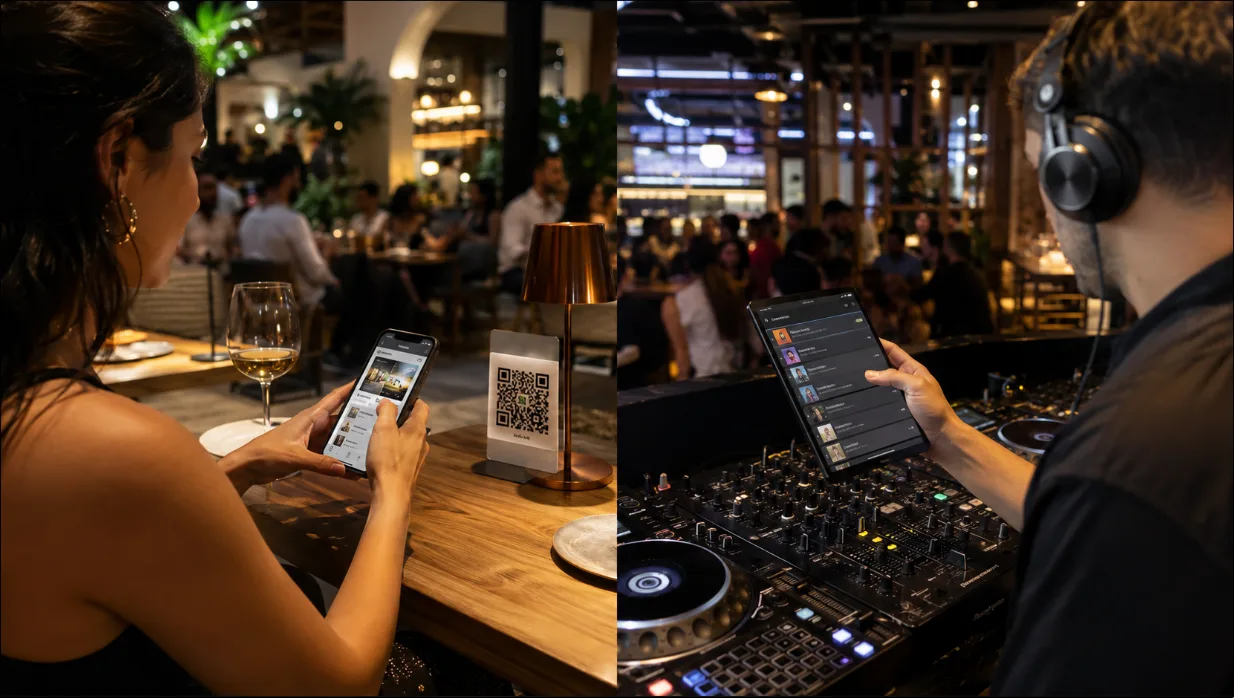
How Tringbox Song Requests Work: QR, Approval, Rewards and Playback
Tringbox song requests are designed around three active participants: the guest, the performer, and the venue. Each has a fundamentally different job during a live event. The guest needs a fast, frictionless way to ask for a track. The performer needs absolute control over what actually enters the set. The venue needs the experience to remain completely compatible with its brand's music policy and daily operations.
The public Tringbox app ecosystem reflects these three roles perfectly through a triad of specialized applications: the consumer experience, the Partner app, and the venue Dashboard. Here is a breakdown of how the platform aligns audience participation with professional venue control.
Song Request App Without a Guest Download: Why Browser-First Requests Win
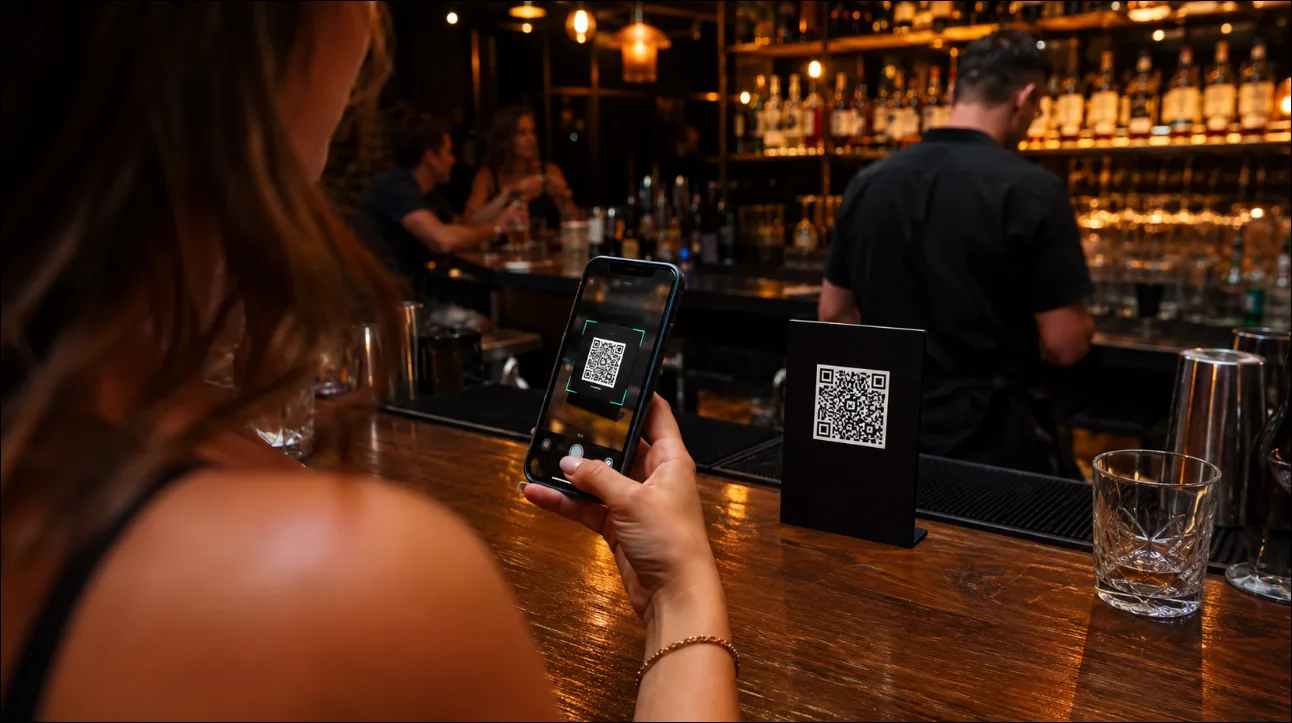
In the live event and hospitality industry, user friction is the ultimate engagement killer. When a guest is on a crowded dancefloor, socializing at a dimly lit cocktail table, or celebrating at a wedding reception, they are not shopping for software. They have a fleeting, spontaneous desire to request a song and immediately return to their friends.
If a venue's QR code intercepts that spontaneous moment and redirects the guest to an iOS App Store or Google Play page, demands a 40-megabyte download, forces them to create a user account, and requires email verification before they can type a song title, the interaction is dead on arrival. Most patrons will simply abandon the process, pocket their phones, and walk away frustrated.
This rapid drop-off is exactly why browser-first, zero-download song request architecture has become the undisputed category standard in modern nightlife and event technology. The guest scans a code, their native mobile browser instantly opens a lightweight web portal, the track is submitted, and the digital interaction concludes in under fifteen seconds. This guide breaks down the structural advantages of no-download request ecosystems, the asymmetric software requirements of DJs versus guests, and the user-experience metrics that operators must test before going live.

Best QR Song Request Apps for Weddings, Clubs and Events in 2027
The era of the handwritten cocktail napkin is officially over. QR song requests have evolved from a post-pandemic novelty into a mandatory category of live entertainment infrastructure. The baseline interaction across all these tools is structurally identical: a guest scans a QR code with their mobile device, submits a track recommendation, and the performer reviews the request on a dedicated screen. What separates the leading products in 2027 is everything that happens around that exact moment.
Modern platforms have heavily diverged to serve specialized use cases. Some applications are deeply engineered for mobile wedding DJs, prioritizing playlist exports and pre-event curation. Others are designed for recurring residencies at high-volume nightclubs, focusing on queue speed and venue analytics. Some integrate seamlessly into professional DJ performance software, while others act as comprehensive hospitality ecosystems connecting background music, live performers, and digital tipping.
This comprehensive industry review breaks down the top QR song request platforms available to entertainers and venue operators in 2027. Note: This article is published by Tringbox and discusses Tringbox alongside other industry solutions. Competitor features, pricing models, and integrations evolve rapidly and should always be verified directly before purchasing or deploying at a live event.

How DJs Can Receive Song Requests From Guests Without Interrupting the Set
The real problem in the modern DJ booth is not the song requests themselves; it is the physical interruption. Most professional DJs do not inherently dislike receiving input from the crowd. What they dislike is the friction of how that input is delivered. A guest leaning over the mixer with a sloshing drink, typing a song title into a blindingly bright smartphone screen, shouting an obscure artist name during a complex harmonic transition, or returning every five minutes to ask when their track will play creates immense operational friction.
This physical interference divides the performer's attention at the exact moment they need to read the room, monitor audio levels, and maintain the dancefloor's energy. The goal for any modern venue or mobile entertainer is therefore not to eliminate requests, but to separate guest input from booth interruption.
By adopting a structured digital workflow, DJs can transform chaotic, demanding crowds into a stream of organized, manageable data. This guide breaks down the psychology of the DJ booth, the implementation of QR-led request channels, queue management, and the best ways to keep the crowd engaged without sacrificing the performer's flow state.
Song Request App for DJs: How QR Requests Actually Work
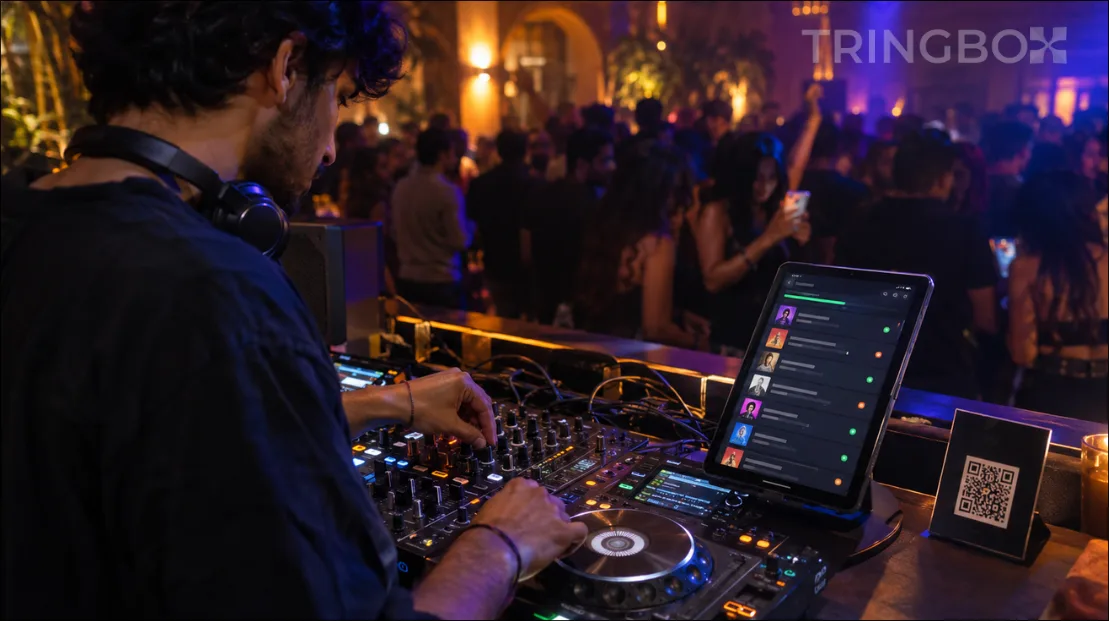
A QR song request system creates a digital bridge between the dance floor and the booth. Instead of approaching the DJ in the middle of a mix, a guest scans a code placed on a table, screen, poster, or venue card. The code opens a lightweight request page where the guest can search or type a song, attach a message if the platform supports it, and submit the request. The DJ receives it in a separate performer interface.
The best systems keep this flow intentionally short. At a noisy event, every extra login screen or mandatory download reduces participation. That is why many current tools use a browser page for guests, even when the DJ has a dedicated app.
The Future of Business Music: From Playlists to Context-Aware In-Store Media
The next generation of commercial business music will not be defined by who possesses the largest digital catalogue. In an era where cloud streaming has commoditized access to tens of millions of licensed tracks, raw library volume has become a baseline operational expectation rather than a competitive differentiator.
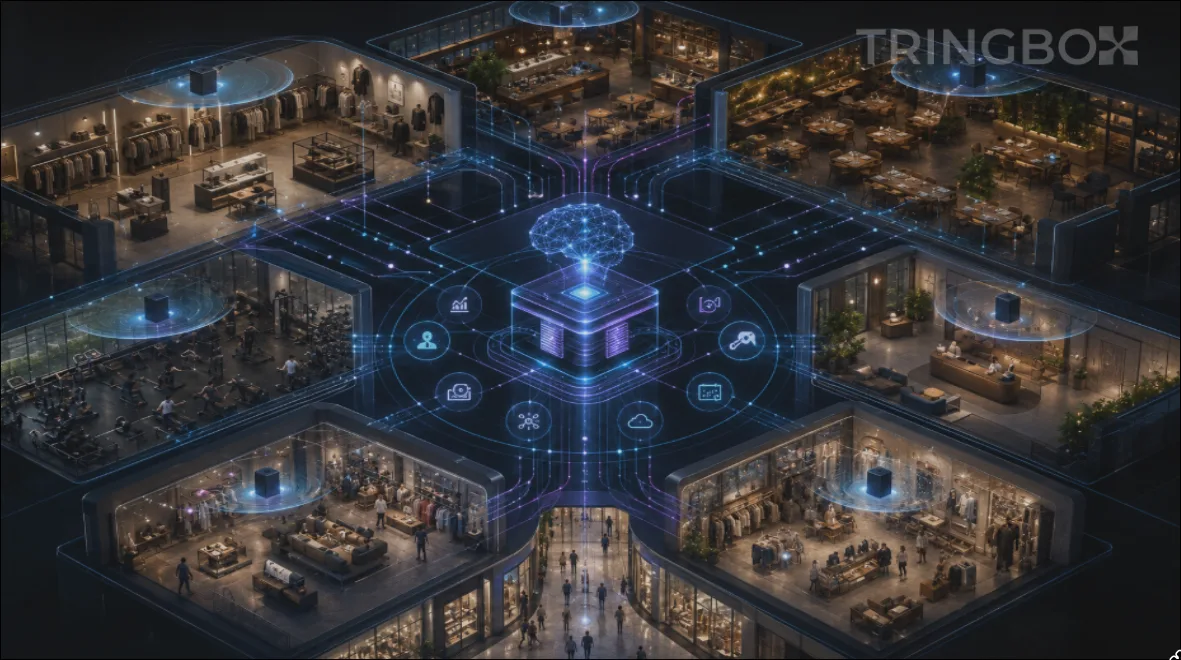
The true strategic frontier of physical commercial audio is shifting rapidly toward orchestration: how acoustic soundscapes intelligently adapt across brand personas, physical venues, operational dayparts, architectural sub-zones, promotional marketing campaigns, and real-time environmental context. Static, looped playlists pushed from a desktop folder are rapidly being rendered obsolete.
This structural transition is already unfolding across the global enterprise landscape. Leading industry commentary projects a deep, agentic convergence between machine-learning automation and expert human curation—transforming physical retail and hospitality spaces into fully unified experiential environments where background sound, promotional voice messaging, digital signage, and lighting work in seamless concert.
Commercial audio is shedding its legacy reputation as passive store decoration and emerging as an essential media operating system for physical real estate. In this forward-looking blueprint, we explore how business music is evolving into context-aware media, how artificial intelligence manages operational nuance at enterprise scale, and how Tringbox AI is defining the category of In-Store AI Music for modern multi-location brands.
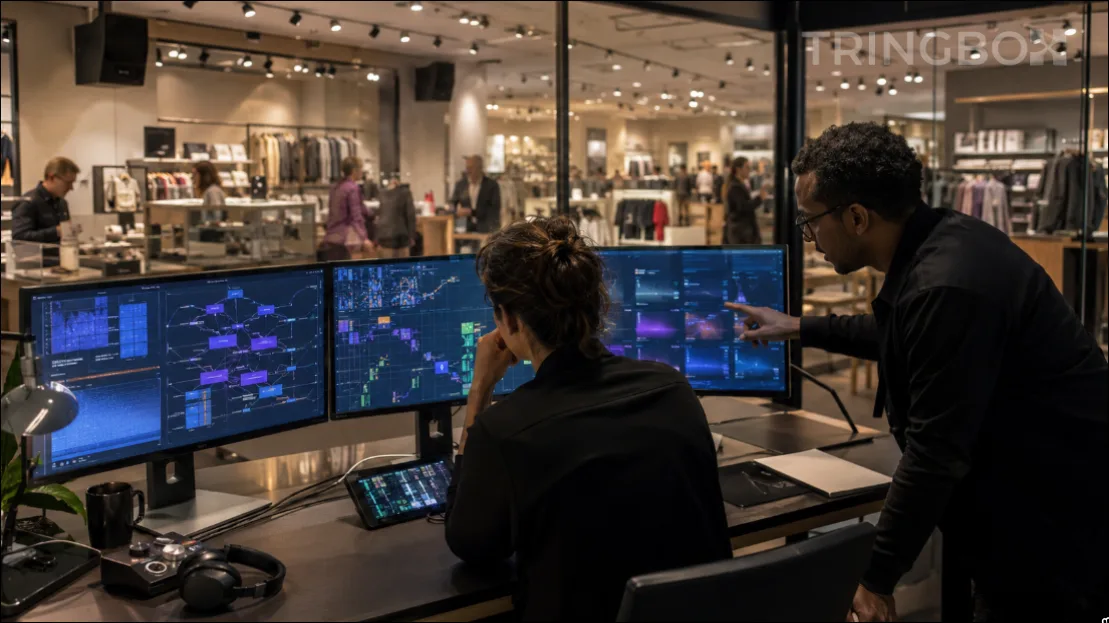
Explainable AI for Business Music: Why “The Algorithm Chose It” Is Not Enough
Artificial intelligence can effortlessly make thousands of complex music sequencing decisions across hundreds of store locations without a single moment of human intervention. However, in an enterprise corporate environment, mathematical scale is completely useless if the business cannot trust the boundaries of the system. When a regional operations manager calls headquarters to ask why a highly unusual or off-brand track played during the Friday evening rush, answering with “the algorithm chose it” is a fundamentally unacceptable operational response.
Modern commercial automation requires deep operational explanations. Store managers, brand directors, and legal teams need to understand the precise mechanical logic behind their acoustic environment. The solution to this 'black box' problem is a rapidly growing field of computer science known as Explainable AI (XAI).
In commercial audio, explainability transforms subjective musical curation from a mysterious digital magic trick into a highly auditable, governable business process. In this technical guide, we explore why enterprise brands require explainable AI, how to map algorithmic decisions to concrete business logic, and how Tringbox AI utilizes transparent decision pipelines to guarantee ultimate brand safety.
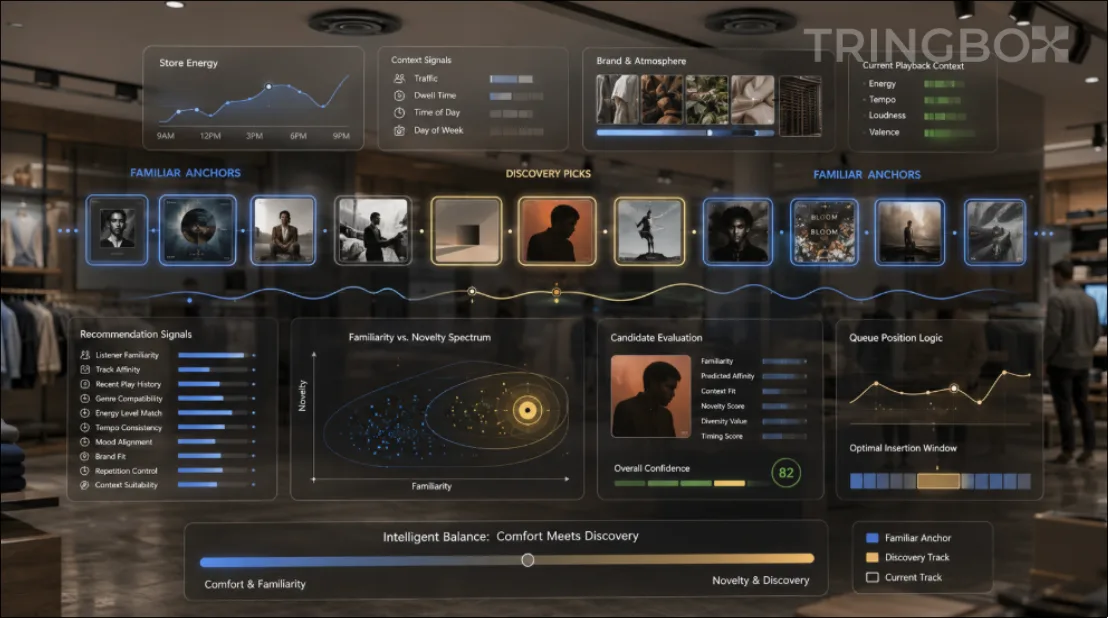
Relevance vs Novelty: The Recommendation Problem Every Business Playlist Eventually Faces
In the complex world of commercial audio curation, a recommendation system that always strictly chooses the absolute safest, most mathematically accurate track will eventually and inevitably become agonizingly boring to everyone in the room. Conversely, a system that constantly searches for extreme surprise and avant-garde discovery will rapidly become wildly inconsistent, alienating core customers and destroying the brand's established identity. The fundamental architectural problem facing modern retail and hospitality brands is not simply finding good music; it is masterfully balancing relevance with novelty across thousands of hours of continuous playback.
This complex trade-off is a well-established dilemma in advanced recommender-system research. In the early days of algorithmic curation, developers focused entirely on 'accuracy'—the probability that a specific track perfectly matched a given set of acoustic tags. However, accuracy alone completely fails to capture whether a continuous recommendation list is actually diverse, fresh, or psychologically engaging over an eight-hour staff shift. Modern academic researchers and data scientists increasingly evaluate algorithms based on 'beyond-accuracy' qualities, specifically focusing on four distinct pillars: diversity, novelty, serendipity, and catalogue coverage.
For multi-location enterprise business music environments, these theoretical data-science concepts translate into direct, measurable operational value. When a music platform fails to manage this balance, operations executives receive endless complaints from store staff about crushing repetition, even when the software claims the music is perfectly 'on-brand.' In this deeply comprehensive technical guide, we will explore exactly why algorithmic homogenization occurs, how dynamic queues function differently than static playlists, and how Tringbox AI utilizes a sophisticated 'explore-exploit' model to guarantee that your brand's soundtrack remains infinitely fresh without ever sacrificing corporate brand safety.
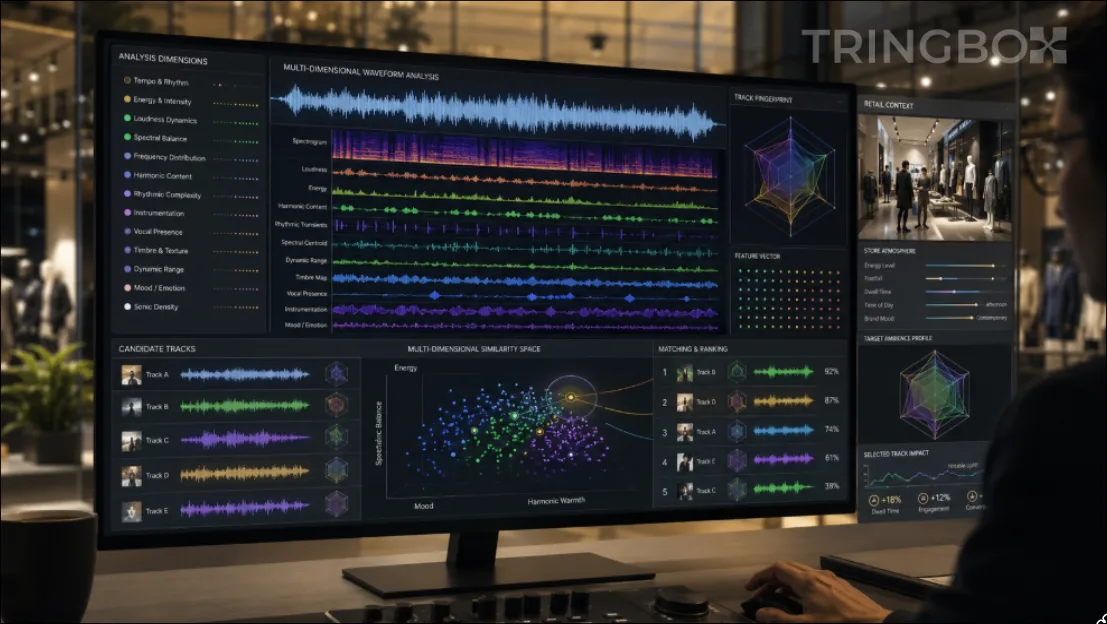
Beyond BPM: What a Business Music Algorithm Should Actually Understand
Beats Per Minute (BPM) is immensely attractive to software developers and retail executives because it appears straightforward. It assigns a clean numerical integer to an audio file, offering the seductive illusion that the emotional art of store atmosphere can be reduced to basic arithmetic. However, relying on tempo alone is one of the fastest ways to destroy in-store brand ambience.
Two songs can clock in at the exact same 110 BPM while generating completely contradictory psychological environments. One recording might be an understated, delicate acoustic ballad featuring gentle finger-picked guitar and whispery vocals—ideal for an intimate afternoon coffee shop or a quiet boutique consultation. The other might be a brutally compressed, industrial electronic track dominated by aggressive sub-bass drops and loud distorted synths—better suited for an intense underground CrossFit gym. An algorithm that evaluates music through the solitary lens of BPM will routinely make confident, disastrous curation errors on the retail floor.
Modern commercial spaces are complex, living environments. A customer reading a menu, trying on clothes, or consulting on luxury jewelry interacts with acoustic frequencies on multiple sensory layers. A business music selection algorithm must look far beyond raw tempo to understand physical audio features, semantic cultural metadata, live commercial context, and strict governance rules. In this comprehensive technical breakdown, we explore the multi-dimensional feature stack required to build an enterprise-grade retail music algorithm, and how Tringbox AI transforms subjective brand strategy into robust, explainable mathematical selection.

Human Curation vs AI Curation: Why Business Music Needs Both
The modern debate surrounding commercial audio curation is almost universally framed as a high-stakes binary competition: either an intuitive human musicologist hand-crafts the soundscape using emotional nuance and cultural awareness, or an algorithmic artificial intelligence engine takes over with mathematical precision, automation, and infinite catalog scale.
In the complex, multi-layered reality of enterprise business operations, that oppositional framing is fundamentally flawed. Human curation and artificial intelligence are not competing against one another; they are engineered to solve two completely different dimensions of the same operational problem.
Human sound architects are uniquely gifted at deciphering meaning, cultural subtext, and emotional resonance. A human curator instantly grasps why an otherwise perfect, mid-tempo song feels completely off-brand inside an ultra-luxury boutique, why a specific lyric creates awkward tension inside a family dining room, or why a trending regional track carries negative historical or political baggage that audio metadata will never show.
Conversely, algorithms excel at mathematical scale, memory retention, and tireless operational execution. An algorithm never forgets a recency rule, effortlessly evaluates hundreds of thousands of tracks against complex negative constraints, calculates real-time transition crossfades, and adapts the sound across five thousand stores simultaneously without experiencing fatigue.
The ultimate enterprise business music system does not choose between them. It leverages human expertise to define and govern the non-negotiable brand taste system, while deploying Tringbox AI to execute, scale, and continuously optimize playback within those boundaries.