
H&M’s Spotify Playlist Hack: What Brands Can Learn About In-Store Music
How curated playlists improved dwell time and where static music tools start to fail in retail
By
Aman Verma
Published
Feb 13, 2026

Global fashion retailers like H&M have experimented with curated in-store playlists such as weekly “Sound of H&M” drops to keep store ambience fresh and culturally relevant. These efforts showed that music can influence how long customers browse and how they emotionally connect with a space. But most brands still rely on static playlist tools from platforms like Spotify, which are not designed to adapt in real time to changing store conditions. This guide breaks down what worked in curated playlist strategies, where they fall short, and how modern retail teams think about adaptive in-store sound.
What Worked in Curated Playlist Strategies
Why Static Playlists Hit a Ceiling
What Modern Retail Ambience Actually Needs
Where Adaptive In-Store Music Fits In
Static vs Adaptive: Practical Differences for Retail Teams
Why This Matters During Sales & Festive Rush
Conclusion
Curated playlists helped brands experiment with sound as a retail tool, but static music systems struggle to keep up with changing store conditions. As physical retail becomes more experience-driven, ambience design is moving from manual curation toward adaptive systems that respond to context. Music becomes most effective when treated as a living layer of the in-store experience rather than a fixed background loop. Explore more practical retail ambience and in-store experience guides at Tringbox blogs.
Never miss music licensing & industry updates
Add Tringbox as a preferred source to see our breakthrough guides, PPL/IPRS compliance updates, and acoustic trends first on Google Search & Discover.
Recommended for you
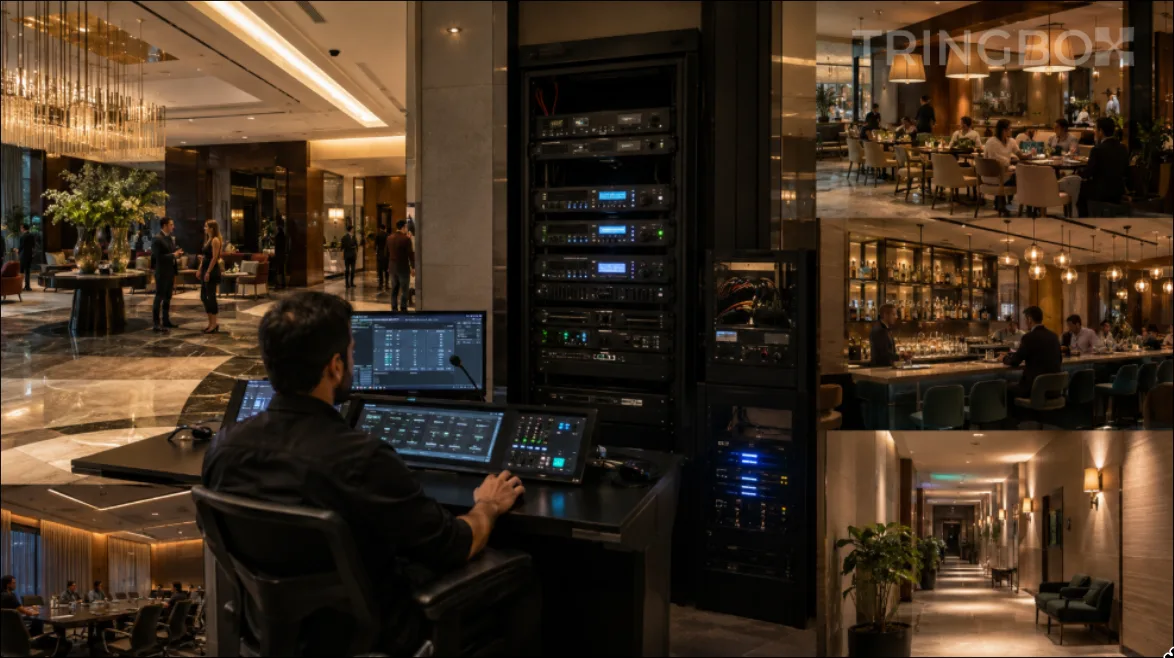
Multi-Zone Music: Why One Location May Need Several Sound Identities
A “location” is not always a single, unified acoustic environment. A luxury hotel can contain a reception lobby, a quiet spa, a fine-dining restaurant, a lively rooftop bar, and a high-energy gym. A massive auto dealership may include a glossy showroom, a relaxed service lounge, and a staff break area. A large fashion flagship store can have a bustling entry, intimate trial rooms, and exclusive premium sections.
Playing one identical audio stream everywhere is operationally simple but experientially crude. Multi-zone music treats each meaningful architectural area as its own distinct playback context while keeping them entirely under one central governance system. In this guide, we explore why large properties require a sophisticated zone strategy to perfect the customer journey.
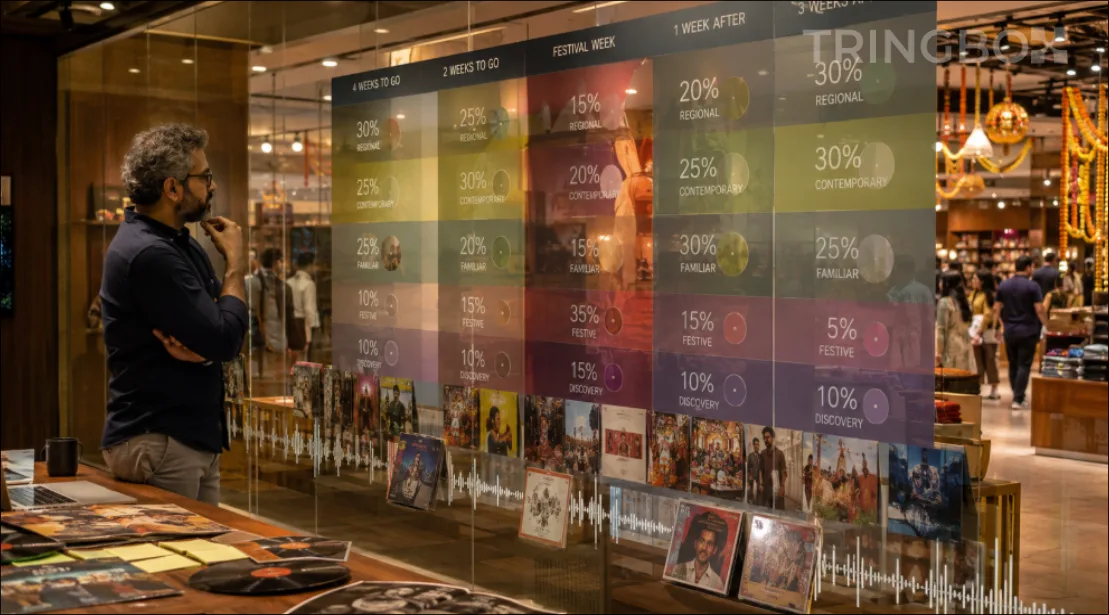
Festival Music Programming for Indian Brands: A Calendar, Not a Playlist
Festive music is one of the easiest ways for an Indian commercial venue to feel culturally current, yet it is simultaneously one of the easiest ways to become agonizingly repetitive. When major holidays like Diwali or Christmas approach, many businesses attempt to solve their festive programming by abruptly replacing their carefully curated brand soundtrack with a generic, themed playlist. The result is almost always excessive familiarity, a jarring loss of brand identity, and severe staff audio fatigue.
The Indian retail calendar is not a single season; it is a relentless, rolling wave of regional and national celebrations. From Makar Sankranti and Pongal in January, through Holi in the spring, to the massive October-December stretch covering Navratri, Durga Puja, Diwali, and the winter wedding season, the celebrations never truly stop. If a brand relies on static playlists for every holiday, they will spend half the year sounding like a generic wedding venue or a community pandal.
A vastly superior operational model treats festivals as a dynamic calendar layer on top of the brand's foundational sonic system. In this comprehensive guide, we explore how multi-location Indian brands can seamlessly integrate festive music for retail stores India without sacrificing their core brand identity, how to legally distinguish background music from event music, and how intelligent platforms like Tringbox AI automate the entire seasonal calendar.
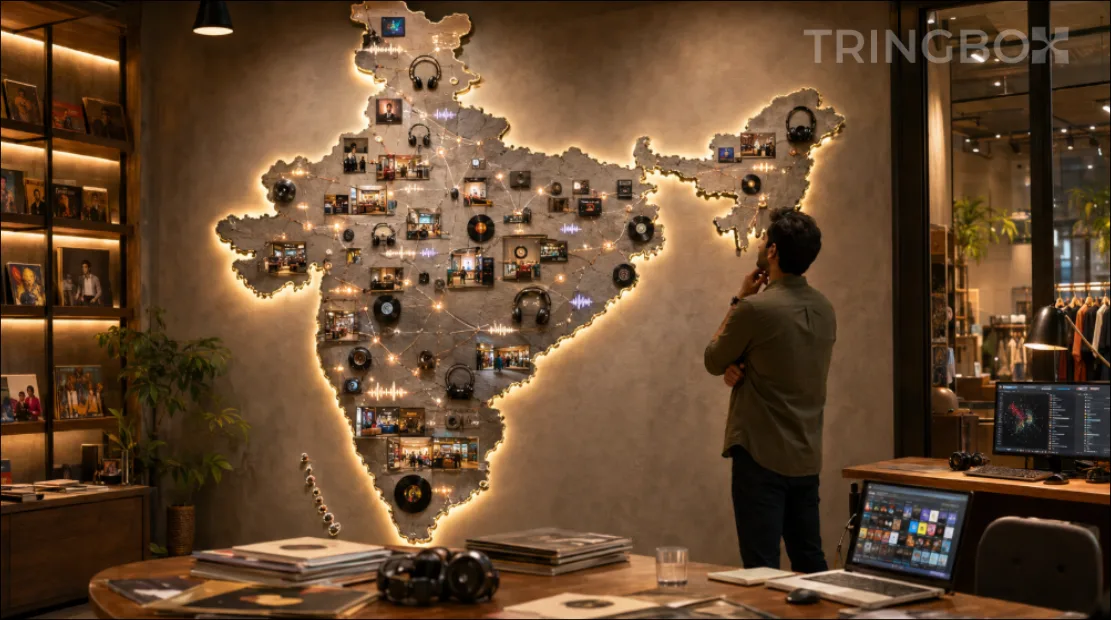
Hindi, English and Regional Music: How Indian Brands Can Localise Without Losing Identity
India creates a localisation challenge that global music strategies frequently underestimate. A national brand operating across the subcontinent must navigate markets with vastly different language preferences, deep musical traditions, shifting customer age profiles, and unique cultural references. Using a single, rigid 'all-India' playlist inevitably feels disconnected and alienating in regional strongholds. Conversely, allowing every individual store manager to improvise their own audio destroys brand consistency completely.
The operational solution is not to mandate a fixed national language ratio. The solution is to architect a highly structured localisation framework. In this guide, we explore how enterprise brands can leverage regional music catalogues dynamically without sacrificing their core acoustic identity.
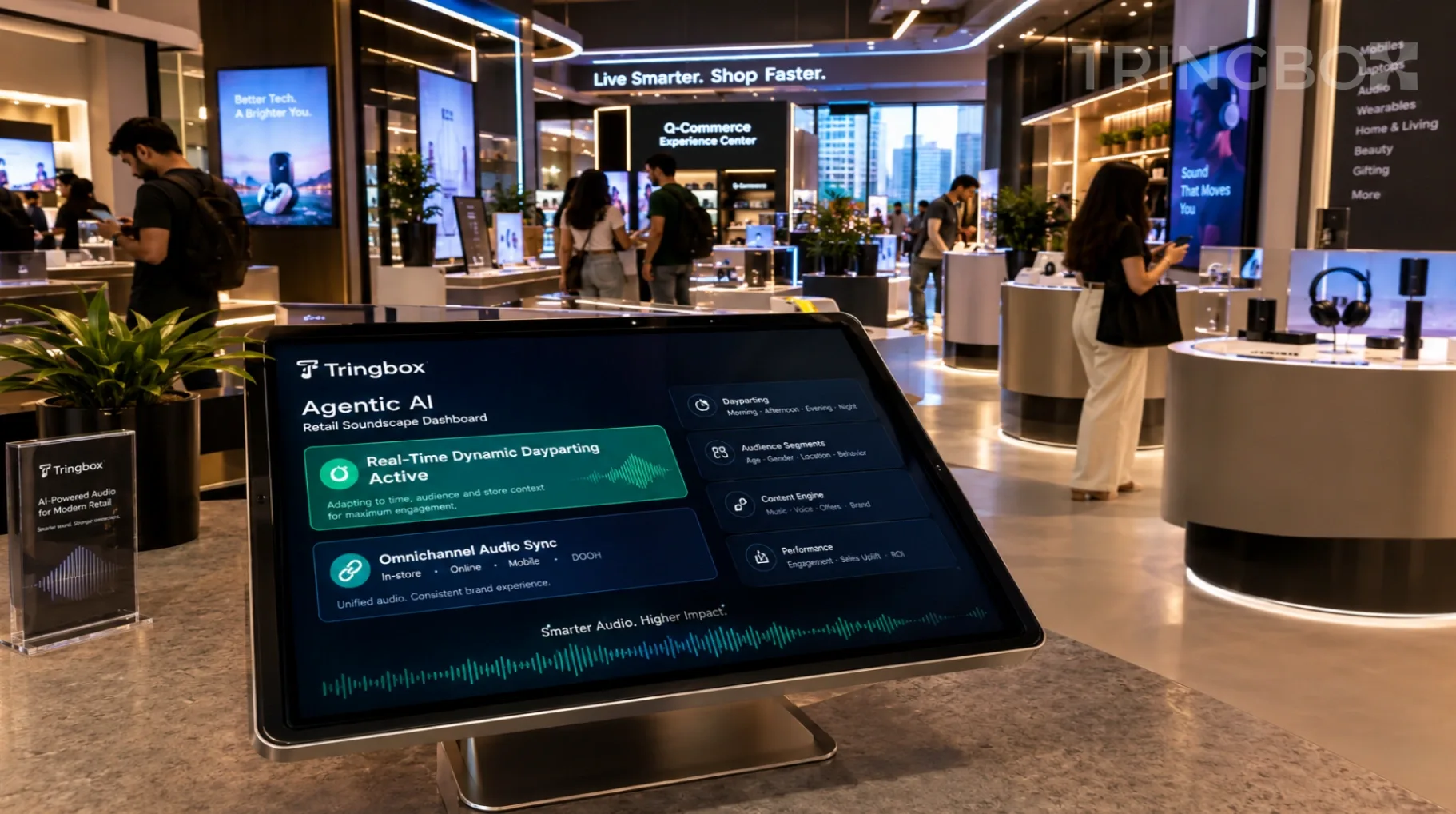
The Rise of Q-Commerce Experience Centers: Elevating Offline Ambience in India's Retail Shift
One of the most defining and disruptive retail trends of late 2026 is the rapid, aggressive evolution of India's Quick Commerce (Q-Commerce) sector. Major logistics and delivery platforms that previously dominated the ultra-fast, 10-minute digital delivery space are now pivoting to expand their physical footprints. These brands are launching premium, omnichannel 'Experience Centers' across tier-1 cities like Mumbai, Bengaluru, Delhi NCR, and Hyderabad. These sophisticated brick-and-mortar hubs are designed to build tangible brand trust, showcase premium direct-to-consumer (D2C) goods, and serve as high-tech customer engagement zones rather than just fulfillment dark stores. However, transitioning from a purely digital app interface to a physical environment introduces a highly complex operational challenge: how do you translate the speed, reliability, and tech-forward identity of a digital native brand into a physical, multi-sensory environment? The answer lies in programmed, data-driven audio. Tringbox's Agentic AI platform is uniquely positioned to bridge this omnichannel gap, delivering dynamic in-store music that matches the hyper-modern identity of 2026's new retail pioneers.

The Cold-Start Problem: How Do You Build a Music Persona for a New Brand?
In the world of artificial intelligence and machine learning, recommendation systems are notoriously data-hungry. They become exponentially smarter, more accurate, and more nuanced when they have years of historical data to learn from. A legacy retail brand that has successfully approved, played, and tracked tens of thousands of songs across hundreds of locations over five years provides a massive treasure trove of empirical data. An algorithm can easily analyze that vast playback history, identify exactly what works, and effortlessly suggest the perfect next track.
But what happens when you are launching an entirely new retail concept, radically rebranding a legacy hotel chain, or opening your very first flagship boutique? You have a stunning logo, a meticulously crafted brand deck, high-end architectural renderings, and perhaps a few vague musical references from the creative director. You have absolutely zero historical playback data. In data science, this structural hurdle is universally known as the Cold-Start Problem.
How do you make highly accurate, brand-safe, and emotionally resonant audio selections before your intelligent system has accumulated enough real-world behavioral data to train its models? If you simply guess, or if you rely entirely on a generic 'Pop' or 'Lounge' category, you risk launching a multi-million-rupee physical space with an incredibly cheap, disjointed, and generic atmosphere.
Overcoming the cold-start problem in commercial audio requires a completely different operational methodology. It requires translating abstract visual and demographic brand strategy into highly specific, mathematically measurable acoustic parameters. In this comprehensive strategic guide, we break down exactly how modern operations and marketing leaders can architect a definitive sonic persona from absolute scratch, how to avoid the dangerous trap of 'founder bias,' and how Tringbox AI bridges the gap between boardroom workshops and flawless store-floor execution.
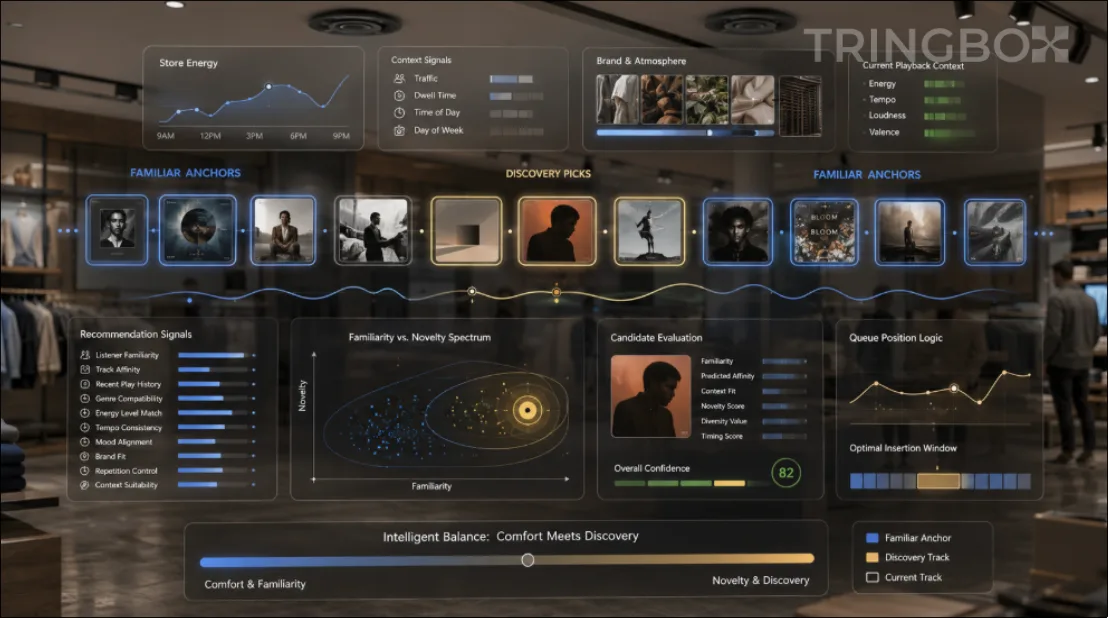
Relevance vs Novelty: The Recommendation Problem Every Business Playlist Eventually Faces
In the complex world of commercial audio curation, a recommendation system that always strictly chooses the absolute safest, most mathematically accurate track will eventually and inevitably become agonizingly boring to everyone in the room. Conversely, a system that constantly searches for extreme surprise and avant-garde discovery will rapidly become wildly inconsistent, alienating core customers and destroying the brand's established identity. The fundamental architectural problem facing modern retail and hospitality brands is not simply finding good music; it is masterfully balancing relevance with novelty across thousands of hours of continuous playback.
This complex trade-off is a well-established dilemma in advanced recommender-system research. In the early days of algorithmic curation, developers focused entirely on 'accuracy'—the probability that a specific track perfectly matched a given set of acoustic tags. However, accuracy alone completely fails to capture whether a continuous recommendation list is actually diverse, fresh, or psychologically engaging over an eight-hour staff shift. Modern academic researchers and data scientists increasingly evaluate algorithms based on 'beyond-accuracy' qualities, specifically focusing on four distinct pillars: diversity, novelty, serendipity, and catalogue coverage.
For multi-location enterprise business music environments, these theoretical data-science concepts translate into direct, measurable operational value. When a music platform fails to manage this balance, operations executives receive endless complaints from store staff about crushing repetition, even when the software claims the music is perfectly 'on-brand.' In this deeply comprehensive technical guide, we will explore exactly why algorithmic homogenization occurs, how dynamic queues function differently than static playlists, and how Tringbox AI utilizes a sophisticated 'explore-exploit' model to guarantee that your brand's soundtrack remains infinitely fresh without ever sacrificing corporate brand safety.
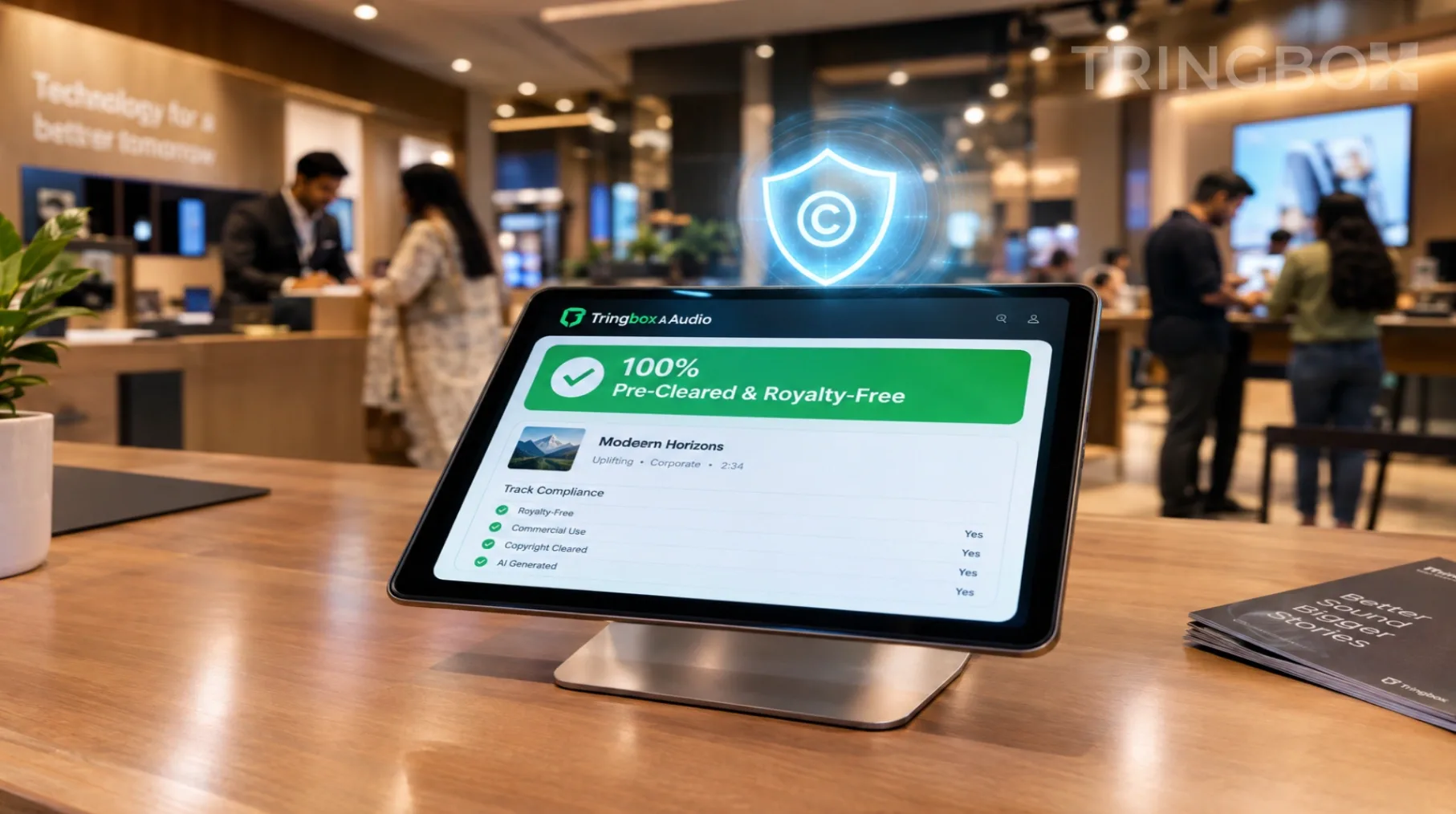
Navigating the 2026 AI Copyright Rulings: Why Commercial Brands Must Avoid Unverified Generative Audio
The commercial music landscape in late 2026 is defined by unprecedented legal scrutiny surrounding artificial intelligence. Specifically, international and Indian courts are aggressively targeting generative AI audio platforms that were trained on copyrighted musical works without explicit authorization from original rights holders. For multi-location Retail Stores, Hotels, and Cafes, the temptation to drastically cut licensing costs by broadcasting cheap, fully synthetic, AI-generated background music has become a catastrophic legal trap. Recent high-profile rulings have made it unequivocally clear: utilizing music generated by unlicensed machine learning models in a public commercial setting carries the exact same, if not substantially greater, legal liability as pirating traditional studio tracks. Corporate legal teams are now blacklisting generative audio tools to avoid massive enterprise liability. This comprehensive guide breaks down the recent regulatory shifts of 2026 and explains why Tringbox's specific architectural approach—using Agentic AI strictly to curate and schedule, rather than to generate audio—provides the ultimate legal firewall for your business.
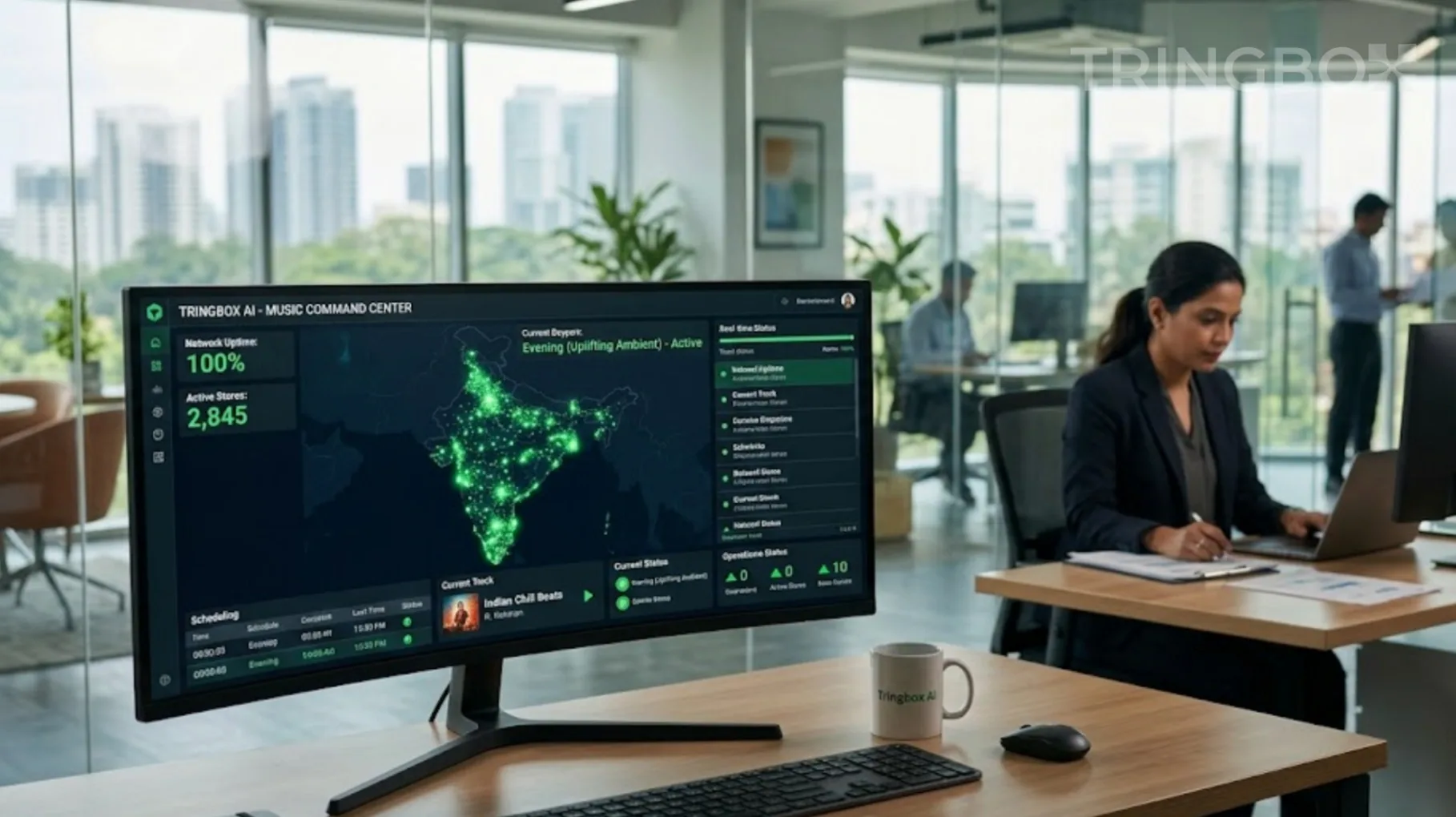
The Music Command Center Every Retail and Hospitality Brand Needs
Music inside a commercial space is no longer just a nice-to-have background layer. It is part of how a customer reads the brand before speaking to staff, before scanning a menu, before entering a trial room, and before making a purchase decision. A store can have great lighting, good fragrance, trained teams and premium interiors, but if the music does not match the moment, the overall ambience can still feel disconnected. Whether operating a Retail Store, a premium Restaurant, a bustling Cafe, or a Hotel Lobby / Reception, the challenge is not simply to play songs. The challenge is to shape a repeatable emotional experience across many physical locations, many time slots and many customer moods. This is where Tringbox AI positions music as an operating system for ambience, not as a playlist dumped into a speaker. The core promise is simple: real-time visibility into music across stores. For Tringbox, this is not a cosmetic feature. It is a way to make every physical space feel more intentional, more aligned with the brand and more responsive to the customer moment.

Human Curation vs AI Curation: Why Business Music Needs Both
The modern debate surrounding commercial audio curation is almost universally framed as a high-stakes binary competition: either an intuitive human musicologist hand-crafts the soundscape using emotional nuance and cultural awareness, or an algorithmic artificial intelligence engine takes over with mathematical precision, automation, and infinite catalog scale.
In the complex, multi-layered reality of enterprise business operations, that oppositional framing is fundamentally flawed. Human curation and artificial intelligence are not competing against one another; they are engineered to solve two completely different dimensions of the same operational problem.
Human sound architects are uniquely gifted at deciphering meaning, cultural subtext, and emotional resonance. A human curator instantly grasps why an otherwise perfect, mid-tempo song feels completely off-brand inside an ultra-luxury boutique, why a specific lyric creates awkward tension inside a family dining room, or why a trending regional track carries negative historical or political baggage that audio metadata will never show.
Conversely, algorithms excel at mathematical scale, memory retention, and tireless operational execution. An algorithm never forgets a recency rule, effortlessly evaluates hundreds of thousands of tracks against complex negative constraints, calculates real-time transition crossfades, and adapts the sound across five thousand stores simultaneously without experiencing fatigue.
The ultimate enterprise business music system does not choose between them. It leverages human expertise to define and govern the non-negotiable brand taste system, while deploying Tringbox AI to execute, scale, and continuously optimize playback within those boundaries.
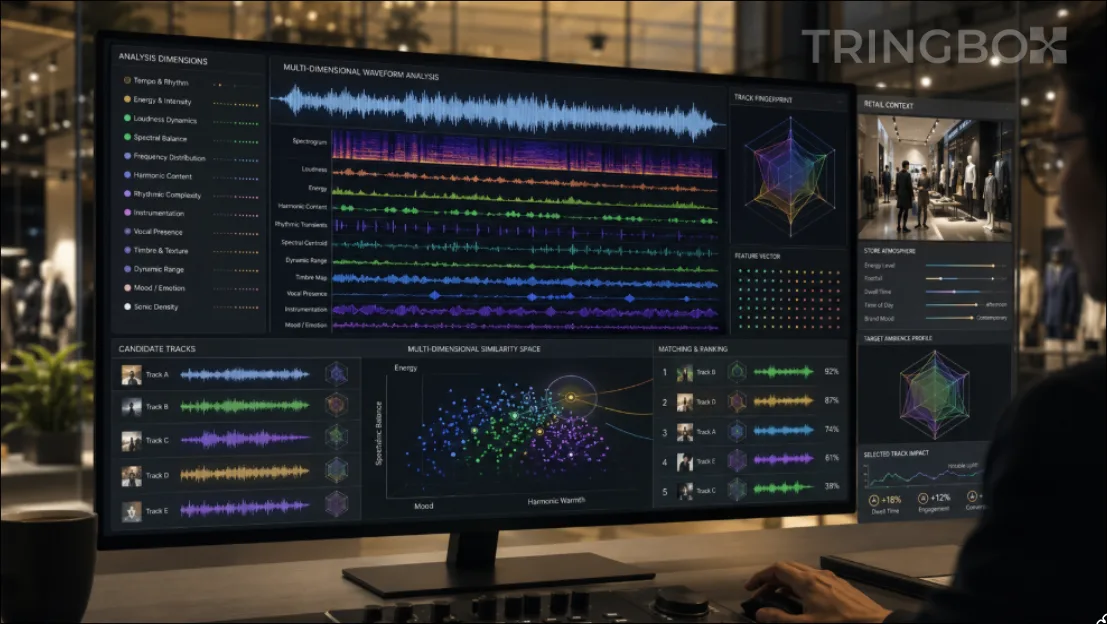
Beyond BPM: What a Business Music Algorithm Should Actually Understand
Beats Per Minute (BPM) is immensely attractive to software developers and retail executives because it appears straightforward. It assigns a clean numerical integer to an audio file, offering the seductive illusion that the emotional art of store atmosphere can be reduced to basic arithmetic. However, relying on tempo alone is one of the fastest ways to destroy in-store brand ambience.
Two songs can clock in at the exact same 110 BPM while generating completely contradictory psychological environments. One recording might be an understated, delicate acoustic ballad featuring gentle finger-picked guitar and whispery vocals—ideal for an intimate afternoon coffee shop or a quiet boutique consultation. The other might be a brutally compressed, industrial electronic track dominated by aggressive sub-bass drops and loud distorted synths—better suited for an intense underground CrossFit gym. An algorithm that evaluates music through the solitary lens of BPM will routinely make confident, disastrous curation errors on the retail floor.
Modern commercial spaces are complex, living environments. A customer reading a menu, trying on clothes, or consulting on luxury jewelry interacts with acoustic frequencies on multiple sensory layers. A business music selection algorithm must look far beyond raw tempo to understand physical audio features, semantic cultural metadata, live commercial context, and strict governance rules. In this comprehensive technical breakdown, we explore the multi-dimensional feature stack required to build an enterprise-grade retail music algorithm, and how Tringbox AI transforms subjective brand strategy into robust, explainable mathematical selection.