
Licensed Background Music Without the Daily Back-and-Forth
Why unmanaged music creates legal risk and operational confusion, and how a structured B2B system helps teams operate with confidence.
By
Arjun Varadaraj
Published
Jun 24, 2026

Music inside a commercial space is no longer just a nice-to-have background layer. It is a fundamental operational tool that dictates how a customer reads the brand before speaking to staff, before scanning a menu, before entering a trial room, and before making a final purchase decision. A store can have flawless lighting, a signature fragrance, highly trained teams, and premium interiors, but if the music is legally unmanaged or emotionally mismatched, the overall ambience collapses. For modern retail, hospitality, wellness, and corporate office brands, the challenge is not simply to play songs. The true challenge is to shape a repeatable, legally secure emotional experience across many physical locations without bogging down the operations and finance teams in daily copyright disputes. This is where Tringbox AI positions music as an operating system for ambience—delivering a fully cleared catalog that protects your business. The core promise is simple: a massive reduction in the licensing headache required for commercial music usage, ensuring your brand operates with structure and legal confidence.
1. The Business Problem of Unmanaged Music
2. Why Manual Playlists Create Daily Friction
3. How Tringbox AI Changes the Operating Model
4. What the Customer Actually Feels
5. Why This Matters for Brand ROI
6. Implementation Checklist for Operations Teams
7. Frequently Asked Questions (Q&A)
A: No. The terms of service for all consumer streaming platforms explicitly prohibit the use of their service in commercial, public, or business environments. You are paying for a personal, private listening license, not a commercial public performance license.
A: Yes. Because Tringbox allows headquarters to set strict content guardrails (e.g., no explicit lyrics, no aggressive tempos), local staff cannot play inappropriate music. This entirely eliminates the daily operational back-and-forth regarding music curation.
A: Tringbox provides a fully managed, B2B-cleared catalog. We coordinate the complex rights required for the tracks within our system to be played in your commercial space, acting as a structural shield between your business and copyright enforcement agencies.
This blog is general marketing content and not legal advice. Music licensing obligations can vary by repertoire, rights owner, usage type, location, and contract. Brands should rely on their commercial agreement and professional legal advice for final compliance decisions.
Conclusion
The final result of implementing a structured B2B music solution is profound peace of mind, dramatically stronger brand governance, and the complete elimination of daily operational back-and-forth for store teams who should never be expected to understand music licensing complexity. The future of commercial spaces will not be shaped exclusively by real estate location, product assortment, or architectural design. It will be profoundly shaped by how intelligently and securely brands manage the invisible, psychological layers surrounding the physical customer. Auditory ambience is one of the most powerful of those layers. Tringbox AI is engineered for brands that want to elevate physical spaces with intelligence, absolute consistency, and strict operational clarity. It helps make music less random, less legally dangerous, and entirely aligned with the real purpose of the venue. If music licensing feels like a confusing, daily headache for your operations team, Tringbox AI gives you the definitive, structured way to secure and automate your commercial music.
Never miss music licensing & industry updates
Add Tringbox as a preferred source to see our breakthrough guides, PPL/IPRS compliance updates, and acoustic trends first on Google Search & Discover.
Recommended for you

The Hidden Operating Cost of Employee-Managed Store Playlists
Letting store employees manage music feels incredibly inexpensive because the direct software cost on the monthly P&L is close to zero. The illusion is simple: a store manager plugs in their personal phone, opens a consumer app, and the store has music. However, the real cost of this setup is completely hidden, distributed across dozens of small, daily operational failures: time spent choosing music, inconsistent atmosphere, painfully repeated songs, inappropriate lyrical content, account login problems, severe copyright rights risk, and headquarters having absolutely zero visibility or control.
At one single location, these issues may feel mildly annoying but manageable. Across a scaling national chain of fifty or five hundred stores, they compound into massive operational friction and legal liability. In this analysis, we unpack the invisible labour, brand drift, and copyright risks of employee-managed playlists, and why centralizing music is an urgent operational requirement.
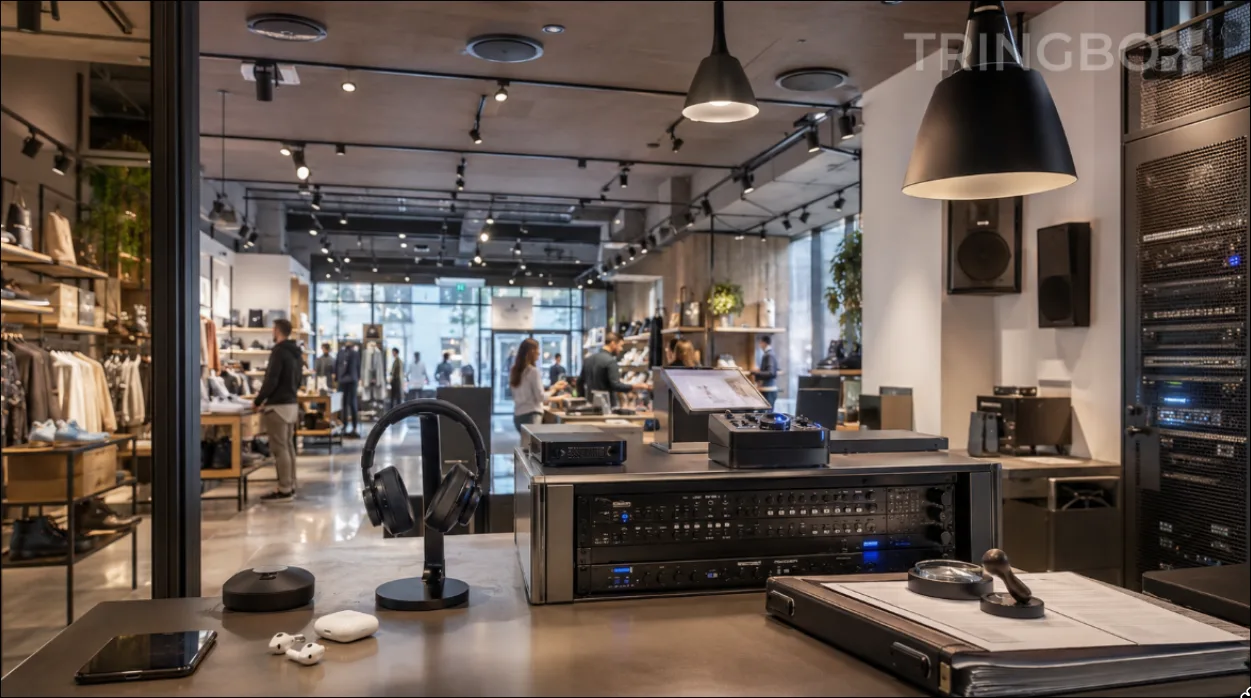
Why Spotify and Apple Music Are Not Business Music Systems
Spotify and Apple Music are undeniably extraordinary consumer products. They feature sleek, world-class user interfaces, host infinite music libraries spanning tens of millions of songs, and can be activated on any smartphone in a matter of seconds. That exact convenience is precisely why retail store clerks, cafe baristas, and restaurant supervisors instinctively plug their personal phones into the store amplifier whenever background music is required.
However, consumer streaming and enterprise business audio are two completely different use cases—both contractually and operationally. Paying for a personal Spotify Premium or Apple Music individual subscription does not give a business the legal or operational right to broadcast that audio across a commercial venue.
When multi-location enterprises rely on consumer apps, they expose their brand to catastrophic statutory copyright fines, destroy store-level governance, and subject their customers to unpredictable, off-brand playlists. In this comprehensive guide, we unpack the explicit legal terms governing consumer streaming in India, examine the operational vulnerabilities of personal apps, and demonstrate why dedicated platforms like Tringbox AI are essential for enterprise brand protection.
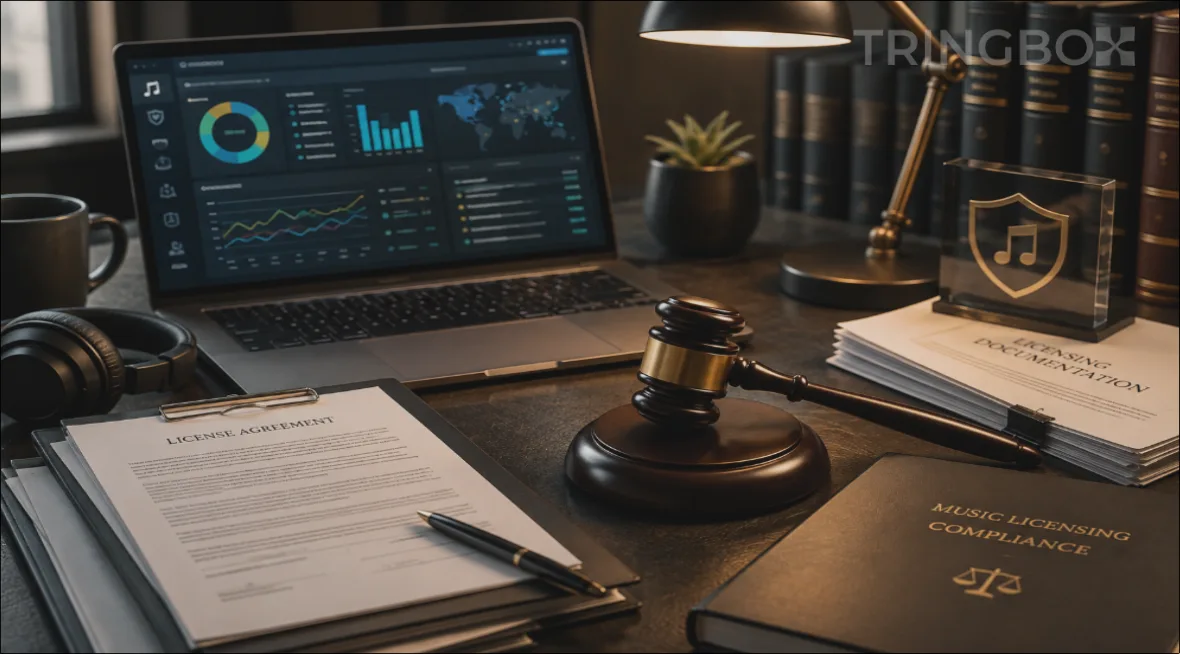
Commercial Music Licensing in India in 2026: A Practical Rights Map for Businesses
Commercial music licensing becomes confusing when businesses ask one broad question: “Is this song licensed?” A more useful approach is to ask which right, for which use, in which repertoire, and by whom. In 2026, that distinction is especially important because Phonographic Performance Limited (PPL India) was officially reinstated as a copyright society for sound recordings by the Government of India on 11 June 2026. PPL's current materials describe public-performance licensing for its represented sound-recording repertoire. Concurrently, IPRS publishes licensing information for musical works and accompanying literary works. This article serves as an operational overview for multi-location brands—not formal legal advice.
What Music Science Does Not Prove: A Guide to Avoiding Overclaims in Retail
Music is undeniably and profoundly emotionally powerful, which makes it incredibly easy for marketers to overstate what academic research actually proves. In the retail and hospitality industry, vendor marketing material frequently jumps from a reasonable, peer-reviewed conclusion—like 'music influenced customer behaviour in one controlled study'—to a massive, unscientific leap like 'this specific tempo releases dopamine and guarantees a 20% increase in sales.'
Those are two fundamentally different claims. A trustworthy, enterprise-grade business must intimately understand the difference between observed behavioral correlation and neurochemical causation. Relying on exaggerated 'audio neuroscience' to drive your store operations creates false expectations and flawed strategies.
In this comprehensive review, we deconstruct the most pervasive myths in commercial music psychology, explore the critical importance of null results, and provide a framework for evaluating in-store music science responsibly. By grounding your strategy in reality rather than marketing hyperbole, platforms like Tringbox AI help brands design effective, evidence-aware acoustic environments.

What 30+ Years of Research Actually Says About Music in Retail
Background music has been rigorously studied in commercial environments for over four decades. Yet, a quick search on the internet often reduces this vast, nuanced academic literature to a handful of highly dramatized, clickbait statistics promising instant revenue multipliers. Blogs frequently declare that slow music guarantees higher spending, or that loud music instantly drives fast-food table turnover, presenting these concepts as unbreakable laws of physics.
A closer, more responsible reading of the actual scientific literature reveals something far more useful and complex: music absolutely possesses the power to influence customer responses, but those effects depend heavily on contextual variables, acoustic fit, and the specific operational outcome being measured. There is no magical playlist that guarantees a 15% increase in sales across every vertical.
For enterprise operations and marketing leaders, understanding the real science is critical to designing a robust sonic strategy. In this comprehensive review, we strip away the marketing folklore and examine what over thirty years of peer-reviewed research actually proves about in-store music, how acoustic congruence drives brand equity, and how Tringbox AI operationalizes this data to build evidence-aware commercial environments.

Music and Waiting: Can the Right Sound Make Queues Feel Better?
Waiting is undeniably one of the most emotionally sensitive and volatile moments in any customer journey. A long queue at a retail checkout, a delay at a premium salon reception, an extended wait in a healthcare clinic, or a crowded restaurant host stand can feel agonizingly slow when customers are bored, anxious, or physically uncomfortable. In these high-friction moments, the entire brand experience is placed under a microscope, and customer satisfaction can plummet in a matter of minutes.
For decades, commercial venue operators have instinctively used background music to improve these spaces, operating under the widespread assumption that playing the right songs will magically make the wait feel shorter. However, behavioral science and acoustic research do not support this simplistic claim. The psychological relationship between background music, time perception, and customer emotion is vastly more complex.
Music absolutely possesses the power to rescue a frustrating waiting experience, but it does so by altering the customer's emotional state, not necessarily by manipulating their internal clock. In this operational breakdown, we explore the academic research behind musical tempo and time perception, why generic 'relaxing' music often fails, how to zone your waiting areas effectively, and how Tringbox AI utilizes journey-based programming to soothe customer anxiety precisely when it matters most.
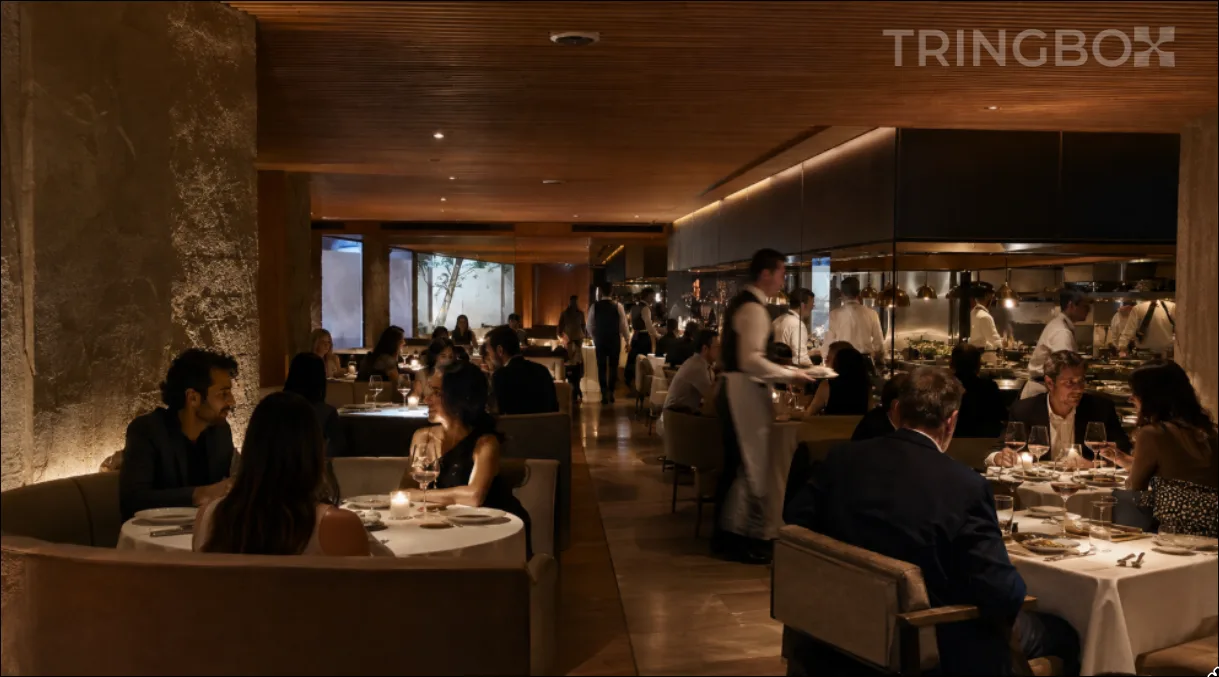
Restaurant Music Tempo: What the Research Actually Says
Restaurant music advice is full of confident, almost magical formulas: slow music makes people stay longer; fast music increases table turnover; louder music increases spending. The academic literature, however, is significantly more complex, highly nuanced, and far less absolute.
For multi-location hospitality operators, the most useful approach is to deeply understand what individual scientific studies actually found, where they were conducted, and—crucially—what they did not prove. Relying on generalized acoustic myths can lead to poorly optimized dining rooms and frustrated customers. In this review, we break down the real science of Beats Per Minute (BPM) in the dining room, separating proven behavioral science from industry folklore.
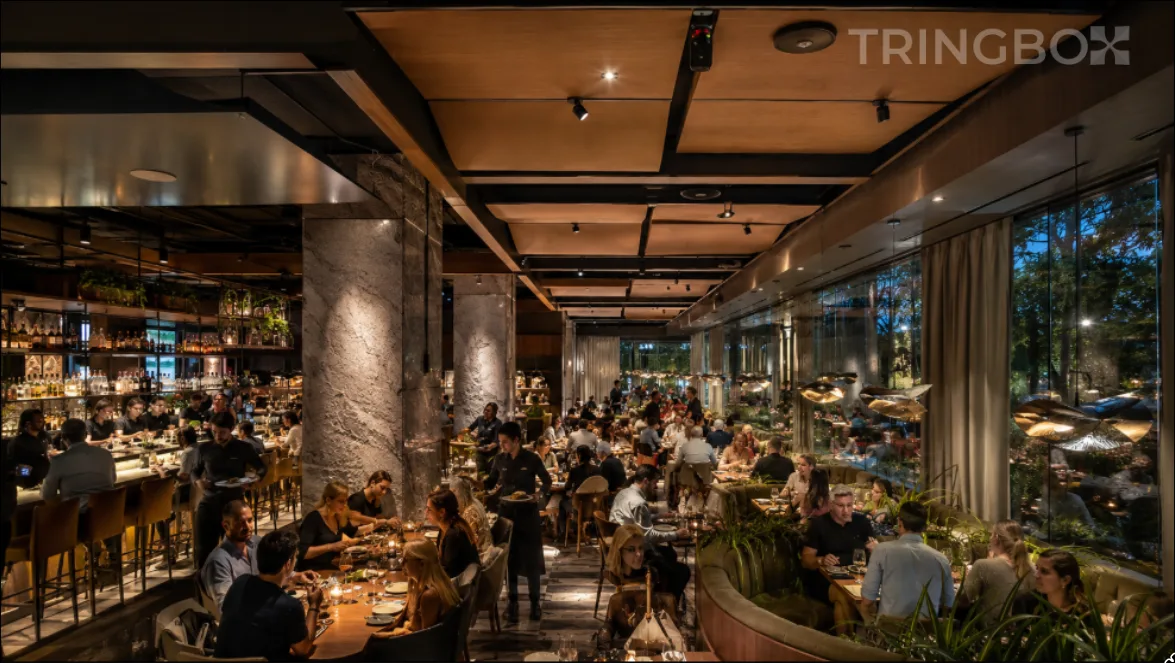
Music Cannot Fix Bad Acoustics: What Restaurants and Stores Need to Understand
In the highly competitive world of modern retail and hospitality, business owners and operations executives frequently fall into a common, expensive trap: they treat their background music system as the entirety of their store’s sound environment. They assume that if they simply license the perfect, curator-approved 'calm' playlist, their chaotic, echoing cafe will magically transform into a serene, premium oasis. This is a fundamental misunderstanding of audio physics and human perception. Music cannot fix bad acoustics.
The reality is that customers do not just hear your music; they consume the entirety of your acoustic environment simultaneously. They hear the low rumble of the HVAC system, the sharp clatter of plates in the open kitchen, the grinding of the espresso machine, the squeak of shopping trolleys, the roar of street traffic, and the complex reflections of human conversations bouncing off hard architectural surfaces. If the physical room is acoustically harsh, highly reflective, or poorly designed, choosing a sophisticated playlist does not automatically make the space feel sophisticated. It merely adds another layer of noise to an already stressful environment.
This critical distinction is especially important in high-density commercial spaces like restaurants, cafes, and open-plan retail stores, where excessive, uncontrolled noise can completely undermine customer comfort, ruin conversational privacy, and actively drive patrons away. In this comprehensive acoustic guide, we will explore why the physical soundscape matters just as much as the digital playlist, how reverberation destroys audio clarity, why speaker placement is paramount, and how brands must integrate intelligent music systems like Tringbox AI with proper physical acoustic treatments to create a genuinely premium customer experience.
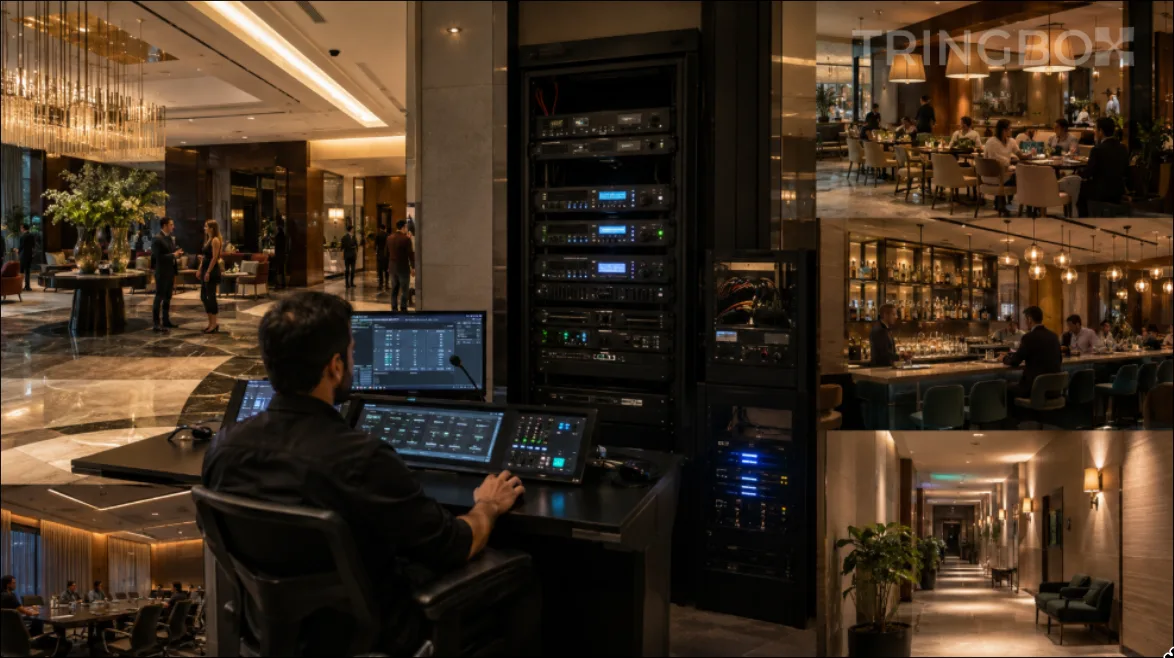
Multi-Zone Music: Why One Location May Need Several Sound Identities
A “location” is not always a single, unified acoustic environment. A luxury hotel can contain a reception lobby, a quiet spa, a fine-dining restaurant, a lively rooftop bar, and a high-energy gym. A massive auto dealership may include a glossy showroom, a relaxed service lounge, and a staff break area. A large fashion flagship store can have a bustling entry, intimate trial rooms, and exclusive premium sections.
Playing one identical audio stream everywhere is operationally simple but experientially crude. Multi-zone music treats each meaningful architectural area as its own distinct playback context while keeping them entirely under one central governance system. In this guide, we explore why large properties require a sophisticated zone strategy to perfect the customer journey.
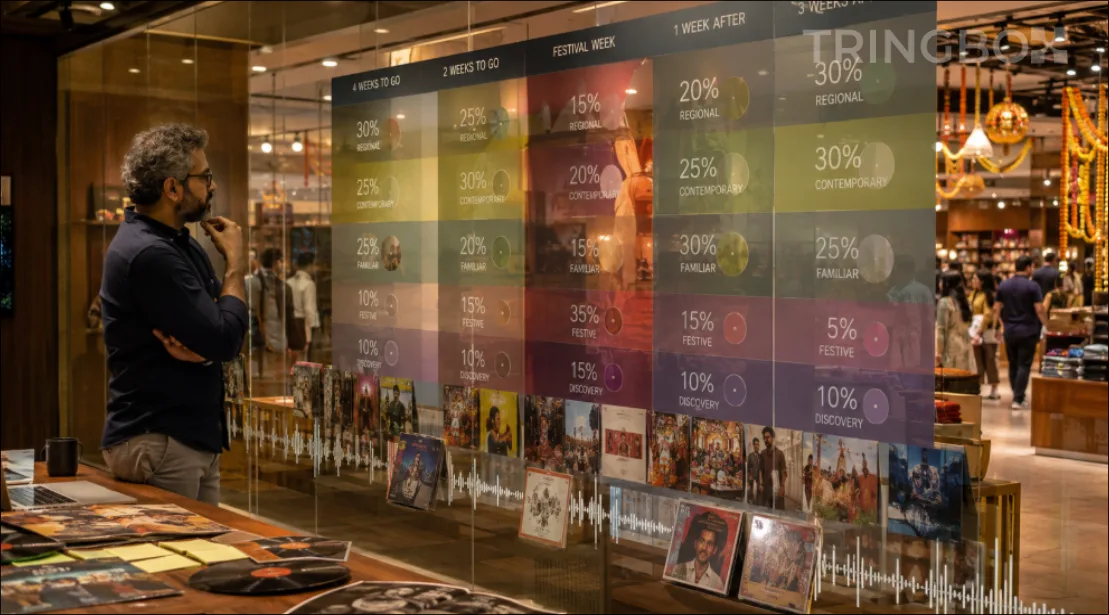
Festival Music Programming for Indian Brands: A Calendar, Not a Playlist
Festive music is one of the easiest ways for an Indian commercial venue to feel culturally current, yet it is simultaneously one of the easiest ways to become agonizingly repetitive. When major holidays like Diwali or Christmas approach, many businesses attempt to solve their festive programming by abruptly replacing their carefully curated brand soundtrack with a generic, themed playlist. The result is almost always excessive familiarity, a jarring loss of brand identity, and severe staff audio fatigue.
The Indian retail calendar is not a single season; it is a relentless, rolling wave of regional and national celebrations. From Makar Sankranti and Pongal in January, through Holi in the spring, to the massive October-December stretch covering Navratri, Durga Puja, Diwali, and the winter wedding season, the celebrations never truly stop. If a brand relies on static playlists for every holiday, they will spend half the year sounding like a generic wedding venue or a community pandal.
A vastly superior operational model treats festivals as a dynamic calendar layer on top of the brand's foundational sonic system. In this comprehensive guide, we explore how multi-location Indian brands can seamlessly integrate festive music for retail stores India without sacrificing their core brand identity, how to legally distinguish background music from event music, and how intelligent platforms like Tringbox AI automate the entire seasonal calendar.