
Proof of Play: Why Businesses Need an Audit Trail for In-Store Music
Learn how timestamped proof-of-play logs transform background audio from an unverified assumption into an auditable operations, legal compliance, campaign delivery, and AI optimization asset across multi-location enterprises.
By
Rohan Mehta
Published
Sep 1, 2026
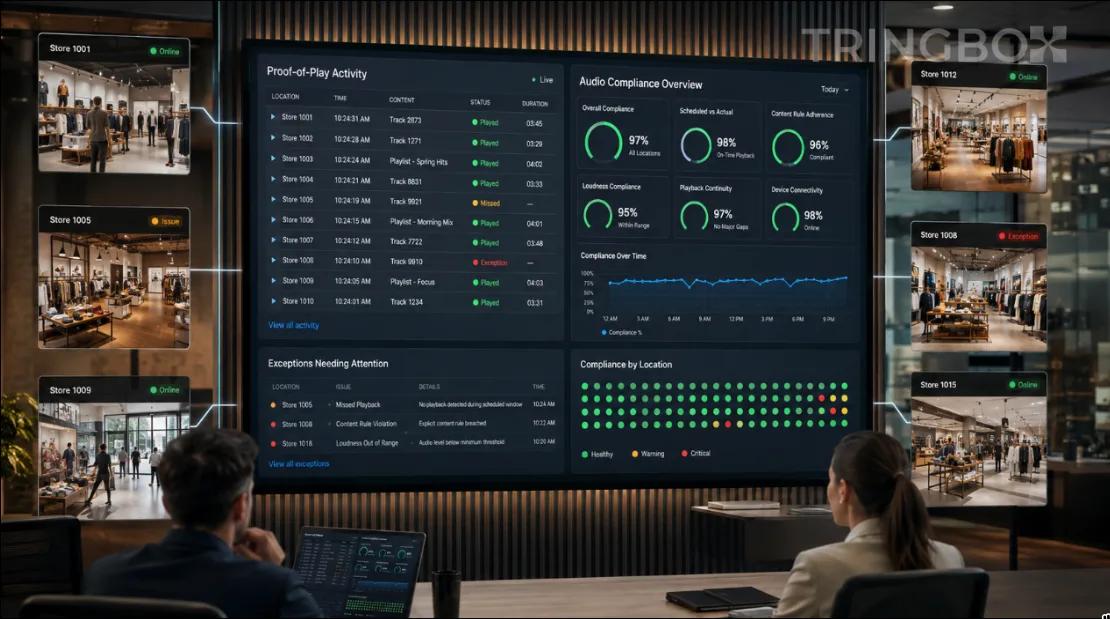
“What is playing inside our stores right now?” sounds like the simplest question a retail founder, Chief Operating Officer, or Chief Marketing Officer could ask. For an enterprise chain operating across fifty, five hundred, or five thousand physical locations, it is often one of the most frustratingly difficult questions to answer with absolute certainty.
A corporate brand marketing team may meticulously assign an audio programme from headquarters, but local edge players can quietly drop offline, store staff can plug in personal phones to override the system, scheduled dayparts can fail to trigger, and regional devices can slowly drift away from corporate brand standards. Without verifiable telemetry, corporate leadership is left managing brand ambience on pure faith rather than hard data.
This is why proof of play transforms commercial background music from an assumed, unverified store-level activity into a recorded, auditable enterprise layer. At its baseline technical definition, proof of play is an immutable, timestamped digital log of every individual audio file, announcement, and campaign that actually rendered through the physical speakers at a specific location or acoustic zone.
At enterprise scale, however, that simple log becomes an indispensable operational asset. It forms the backbone of commercial copyright audit defense, enables precise audio campaign verification, eliminates anecdotal IT support tickets, and feeds vital telemetry into machine-learning recommendation models. In this comprehensive operational guide, we explore why scheduled intent differs from physical execution, how proof-of-play logging safeguards multi-location brands, and why platforms like Tringbox AI build proof of play directly into the core operating system.
1. Assigned Is Not the Same as Played: The Operational Execution Gap
- Unique Location and Zone Identifier: Exactly which store, floor, or sub-zone (e.g., Main Floor vs. VIP Lounge) rendered the track.
- Unique Track and Asset ID: Exact recording identifiers, ISRC codes, and publisher metadata.
- Exact Start and End Timestamps: Millisecond-accurate start time, stop time, and total rendered duration.
- Completion and Playback Status: Verifying whether the track played to 100% completion, was crossfaded by rule, or was prematurely skipped by staff.
- Programme and Scheduling Source: Identifying whether the track was triggered by the central AI schedule, a local override, or an emergency manual fallback.
- Device Telemetry State: Recording player connectivity, local amplifier output status, and cache integrity at the exact moment of playback.
2. Legal Rights, Commercial Licensing, and Royalty Audit Defense
3. Diagnostics and Troubleshooting: Eliminating Anecdotal Support
- Verifying True Repetition: Did the algorithm actually fail and repeat a track, or did the manager simply hear one memorable pop song twice during an eight-hour shift?
- Detecting Crash Loops: Did the media player crash, restart, and mistakenly re-trigger the initial opening track of the morning schedule?
- Identifying Unauthorized Staff Overrides: Did a local employee manually skip songs thirty times in a row until they forced their personal favorite track to play?
- Investigating Acoustic Dead Air: Was a reported period of silence caused by a corrupt audio file, a local hardware disconnect, a failed network stream, or an improper transition crossfade setting?
4. Powering the AI Recommendation and Continuous Discovery Loop
- True Track and Artist Repeat Intervals: Measuring the actual real-world spacing between plays across thousands of stores.
- Catalogue Coverage Percentages: Identifying whether the recommendation model is actively utilizing the full approved library or collapsing into a narrow rotation of high-probability tracks.
- Daypart Performance and Velocity: Tracking which tempo curves and energy profiles correlate with longer customer dwell times across specific store tiers.
- Localized Skip and Override Rates: Flagging specific songs or genres that are consistently rejected by on-the-ground store teams, signaling an acoustic mismatch with the venue.
5. Tailored Telemetry: Designing Distinct Reports for Different Stakeholders
6. Offline-First Logging Architecture and Data Integrity
7. Customer Privacy by Design: Venue-Centric Telemetry
8. Enterprise Procurement Checklist for Proof of Play
- Confirmed Render vs. Scheduled Intent: Do playback logs record actual audio render events through the hardware output, or do they simply mirror the scheduled calendar?
- Offline Event Queuing: Does the local media player store an offline playback database locally during network outages and automatically sync upon reconnection?
- Multi-Zone Logging: Can the platform track and separate proof-of-play logs across distinct audio zones (e.g., Dining Room vs. Restrooms vs. Kitchen) within the same physical address?
- Campaign and Announcement Auditing: Are promotional in-store voice announcements and audio advertisements tracked and reported independently from background music tracks?
- Data Retention Standards: Does the vendor guarantee a minimum of 12 to 24 months of historical proof-of-play data retention with instant CSV/API export capabilities?
- Discrepancy Reporting: Does the dashboard automatically highlight discrepancies between scheduled target dayparts and actual rendered playback?
9. Frequently Asked Questions (FAQs)
A: Consumer streaming services (like Spotify or Apple Music) only log basic stream starts on personal accounts; they provide zero store-level location metadata, no zone tracking, no staff override visibility, and no offline render verification. Furthermore, using consumer accounts in a commercial space is illegal under public performance copyright law.
A: Not at all. Proof-of-play telemetry consists of ultra-lightweight, compressed text packets. A full day of store logging uses less bandwidth than loading a single webpage. Furthermore, systems like Tringbox AI batch and throttle telemetry uploads to ensure zero interference with Point-of-Sale or customer Wi-Fi networks.
A: No. Tringbox handles all music licensing completely for you. Your subscription includes full B2B commercial public performance rights, shielding your store from copyright audits, society fees, or individual registrations with PPL or IPRS.
A: Tringbox securely archives full, timestamped proof-of-play and campaign delivery logs for up to 24 months in enterprise cloud storage, allowing corporate legal, marketing, and operations teams to generate on-demand compliance reports whenever needed.
A: Yes. Advanced media player telemetry monitors both software audio output levels and physical hardware status. If an on-site associate mutes the system or drops the master volume below the approved operational threshold, the central dashboard logs the event and triggers an exception alert to the regional manager.
Conclusion
Proof of play may not be the most glamorous feature in commercial audio, but for multi-location retail, restaurant, and hospitality chains, it is the definitive foundation of operational excellence. It bridges the dangerous gap between boardroom strategy and store-floor execution, protects the enterprise from copyright and compliance vulnerabilities, empowers IT teams with instant diagnostic data, and feeds vital telemetry into AI recommendation models.
By replacing assumptions and guesswork with immutable, timestamped data, operations leaders gain complete visibility and control over their physical acoustic real estate. With Tringbox AI, every beat, every campaign announcement, and every daypart transition is recorded, governed, and optimized—ensuring your brand ambience is delivered flawlessly across every single location.
Never miss music licensing & industry updates
Add Tringbox as a preferred source to see our breakthrough guides, PPL/IPRS compliance updates, and acoustic trends first on Google Search & Discover.
Recommended for you
Best Music Apps for Businesses in India: 2027 Buyer Guide
A business music app solves a very different problem from a consumer streaming app. The operator is not simply choosing songs for personal listening. A business may need music to run for ten or twelve hours every day, remain consistent across locations, continue during connectivity problems, support brand rules, and give head office visibility into what is actually happening in stores.
In India, commercial music rights also need separate attention. That makes the buying decision a combination of music, software, operations and licensing.
Brand-Safe Music Rules: How to Prevent Explicit, Inappropriate or Off-Brand Tracks
In commercial audio programming, an incredibly common and dangerous misconception is that “clean lyrics” automatically equate to “brand-safe music.” This is fundamentally false. A track can contain absolutely zero traditional profanity and still be wildly inappropriate for a family restaurant, a healthcare environment, a luxury retail store, or a corporate workplace.
A song about deep grief, graphic violence, political rebellion, or excessive drug use might pass a basic profanity filter while completely destroying the psychological comfort of your customers. For multi-location enterprises, brand safety cannot rely on a simple "Explicit/Clean" toggle on a consumer app. It requires a sophisticated, layered content policy that evaluates audio through a rigorous corporate lens.
Protecting your physical spaces requires a governance framework that understands context, nuance, and regional sensitivity. In this comprehensive operational guide, we dissect how to move beyond basic explicit-content filtering, how to govern sensitive themes, and how Tringbox AI ensures that every track played across your network mathematically aligns with your corporate risk tolerance.
How to Migrate 100 Stores From Manual Playlists to Central Music Management
Replacing staff-managed playlists across a large multi-location store network is not primarily a software installation project. It is a massive change-management project involving complex brand rules, commercial licensing rights, hardware devices, local network stability, ingrained staff habits, and corporate IT support.
When enterprise retail and hospitality brands scale, the transition from local auxiliary cables to centralized cloud control becomes inevitable. The absolute safest, most effective migration path is a tightly controlled, phased rollout. In this practical operational guide, we provide a step-by-step roadmap for migrating your first 100 stores from chaotic manual playlists to a fully governed, AI-driven business music operating system.
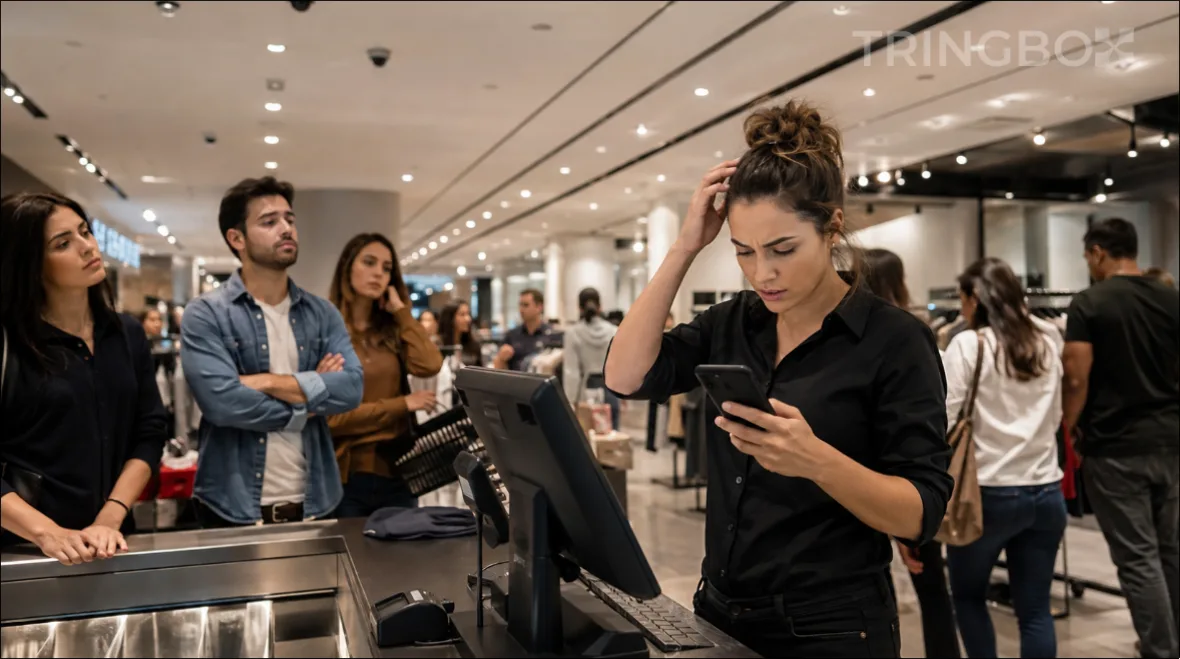
The Hidden Operating Cost of Employee-Managed Store Playlists
Letting store employees manage music feels incredibly inexpensive because the direct software cost on the monthly P&L is close to zero. The illusion is simple: a store manager plugs in their personal phone, opens a consumer app, and the store has music. However, the real cost of this setup is completely hidden, distributed across dozens of small, daily operational failures: time spent choosing music, inconsistent atmosphere, painfully repeated songs, inappropriate lyrical content, account login problems, severe copyright rights risk, and headquarters having absolutely zero visibility or control.
At one single location, these issues may feel mildly annoying but manageable. Across a scaling national chain of fifty or five hundred stores, they compound into massive operational friction and legal liability. In this analysis, we unpack the invisible labour, brand drift, and copyright risks of employee-managed playlists, and why centralizing music is an urgent operational requirement.
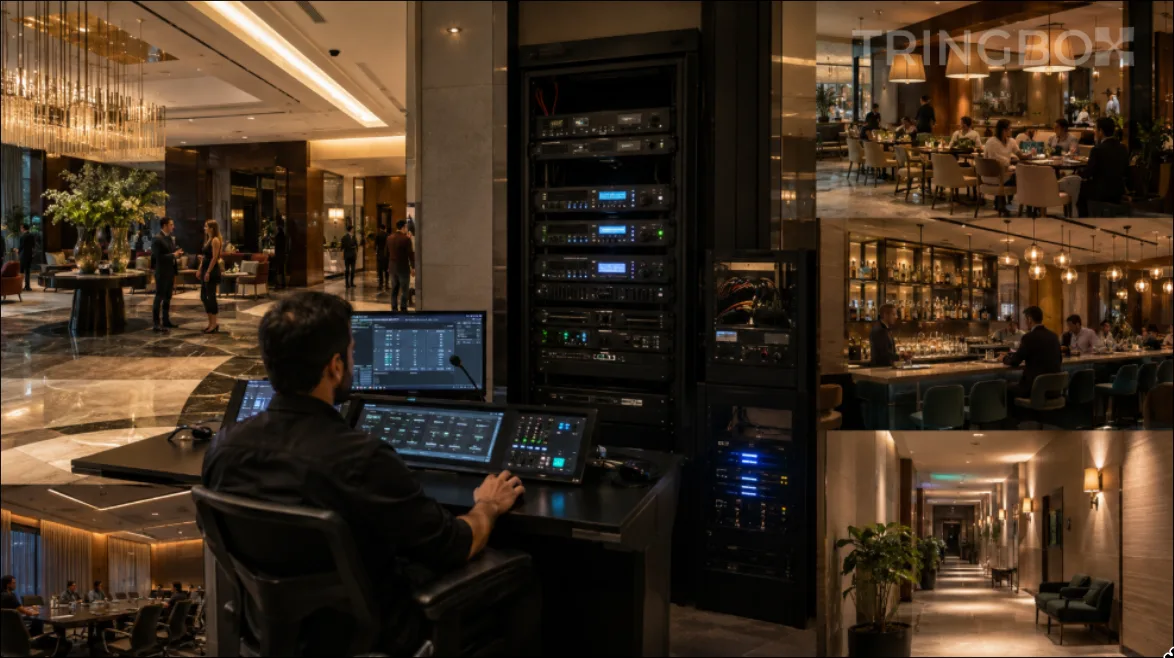
Multi-Zone Music: Why One Location May Need Several Sound Identities
A “location” is not always a single, unified acoustic environment. A luxury hotel can contain a reception lobby, a quiet spa, a fine-dining restaurant, a lively rooftop bar, and a high-energy gym. A massive auto dealership may include a glossy showroom, a relaxed service lounge, and a staff break area. A large fashion flagship store can have a bustling entry, intimate trial rooms, and exclusive premium sections.
Playing one identical audio stream everywhere is operationally simple but experientially crude. Multi-zone music treats each meaningful architectural area as its own distinct playback context while keeping them entirely under one central governance system. In this guide, we explore why large properties require a sophisticated zone strategy to perfect the customer journey.
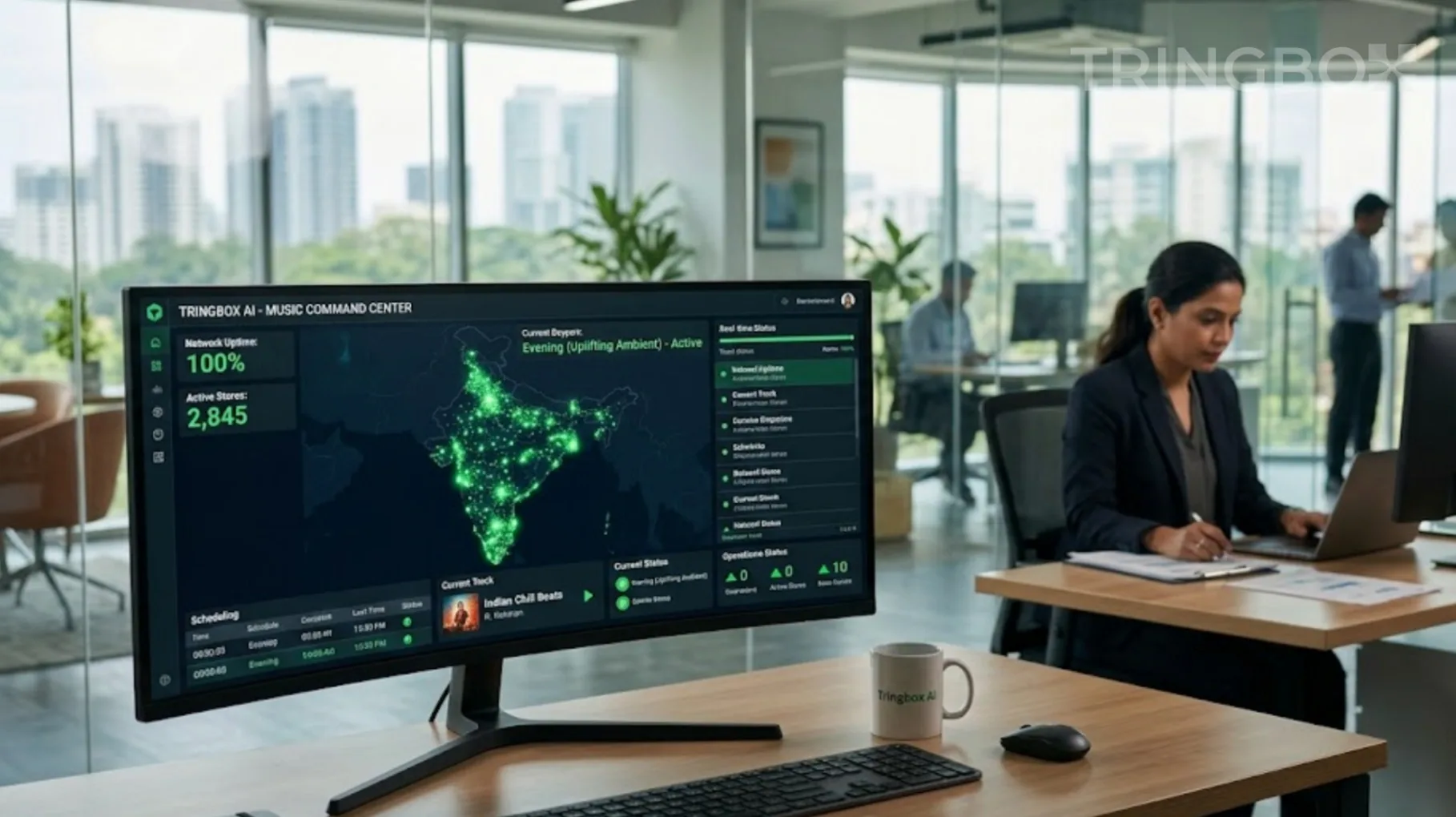
The Music Command Center Every Retail and Hospitality Brand Needs
Music inside a commercial space is no longer just a nice-to-have background layer. It is part of how a customer reads the brand before speaking to staff, before scanning a menu, before entering a trial room, and before making a purchase decision. A store can have great lighting, good fragrance, trained teams and premium interiors, but if the music does not match the moment, the overall ambience can still feel disconnected. Whether operating a Retail Store, a premium Restaurant, a bustling Cafe, or a Hotel Lobby / Reception, the challenge is not simply to play songs. The challenge is to shape a repeatable emotional experience across many physical locations, many time slots and many customer moods. This is where Tringbox AI positions music as an operating system for ambience, not as a playlist dumped into a speaker. The core promise is simple: real-time visibility into music across stores. For Tringbox, this is not a cosmetic feature. It is a way to make every physical space feel more intentional, more aligned with the brand and more responsive to the customer moment.
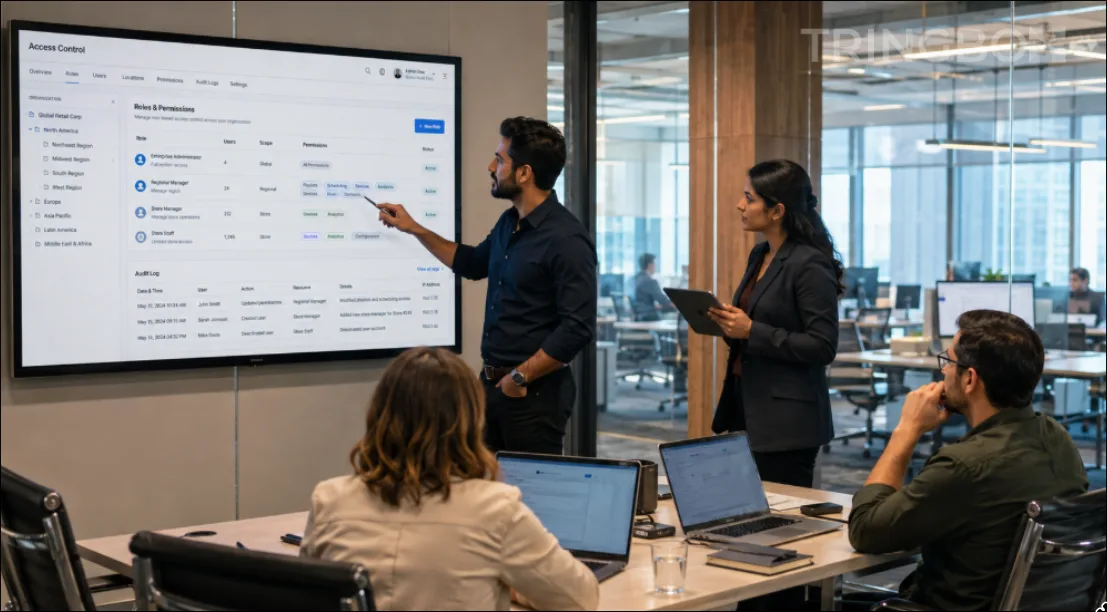
Role-Based Music Permissions: Who Should Be Allowed to Change What Plays?
In many commercial retail and hospitality businesses, in-store music permissions are treated as an oversimplified binary: either store staff have direct access to the audio player hardware, or they do not. While that rudimentary setup might be convenient for an owner-operated single boutique, it introduces immense operational, acoustic, and legal liability for an expanding multi-location enterprise.
A national brand footprint encompasses multiple distinct stakeholders with legitimate, yet competing, daily requirements. Corporate brand marketing demands unwavering sonic consistency and protection of customer emotional memory. Store-level associates need immediate operational flexibility to adjust sound during sudden crowd rushes or system glitches. Regional directors understand hyper-local demographic context and cultural festival nuances. IT helpdesks require network telemetry and hardware diagnostics. Meanwhile, corporate legal and procurement teams need verified proof-of-play logs for commercial copyright compliance.
Handing every single employee the exact same master login credentials or an open auxiliary cable creates unmanaged corporate risk. A frustrated store clerk or a temporary seasonal worker can alter the brand atmosphere of a multi-million-rupee store in seconds with a single tap on a personal smartphone.
Role-Based Access Control (RBAC) has long been the gold standard in enterprise enterprise software, Point-of-Sale (POS) systems, and inventory architecture. In-store commercial audio requires the exact same structural governance. In this comprehensive guide, we map out a practical permissions hierarchy for multi-unit retail, outline how to separate configuration from policy, and show how Tringbox AI bridges corporate strategy, local operations, and artificial intelligence through granular access control.

The Hidden Cost of Employee-Managed Store Playlists: Why Personal Playlists Hurt Retail Growth
In many businesses, the music system begins with an innocent decision: give a store manager or staff member access to a phone, a streaming account, and the venue speakers. It feels flexible, inexpensive, and easy to operate. For a single independent outlet, that arrangement may appear good enough. But as a brand grows, employee-managed playlists create hidden costs that are rarely captured in a music budget. The problem is not simply that one employee may have unusual taste. The deeper issue is that an important part of the customer experience is being handed over without rules, consistency, visibility, or accountability.
Music influences the pace, tone, and emotional character of a physical space. Customers may not remember the exact songs they heard, but they notice when the environment feels disjointed, too loud, too quiet, repetitive, inappropriate, or completely different from another location of the same brand. When employees control the music independently, every shift can sound like a different company. That inconsistency weakens brand identity and makes the experience difficult to manage at scale. This is why leading commercial chains across India are upgrading from informal streaming to automated platforms like Tringbox InStore AI Music.
What Should an In-Store Music SLA Measure?
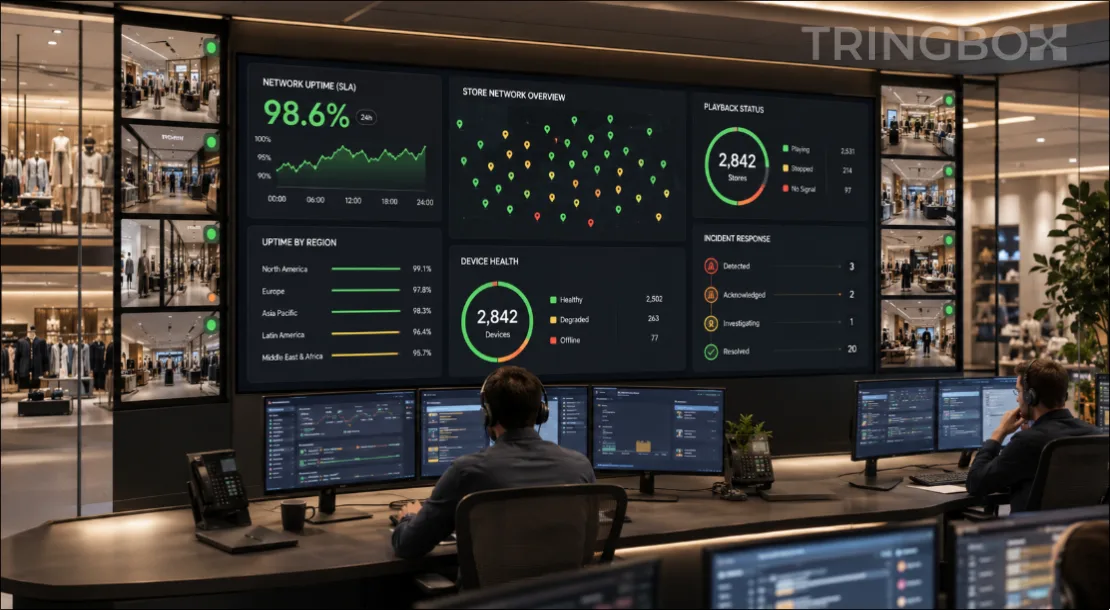
Multi-location retail, restaurant, and hospitality enterprises often procure background music as a creative marketing service, but on the ground, they experience it strictly as operational infrastructure. When a playlist stalls, when an unauthorized explicit song plays, or when a store descends into awkward silence during peak lunch service, the incident escalates straight to the IT and store operations teams, not to a remote music curator.
This operational reality means enterprise contracts and vendor agreements must define service expectations with the exact same mathematical rigor and clarity used for Point-of-Sale (POS) networks, digital signage networks, and enterprise cloud infrastructure. A useful, legally binding Service Level Agreement (SLA) for commercial audio must measure what actually happens on the physical store floor, rather than merely tracking whether a vendor's remote cloud server is technically reachable.
In this comprehensive guide, we unpack the critical layers of an enterprise in-store audio SLA, explore why standard server availability metrics fail physical venues, and outline the exact performance indicators operations leaders must write into their vendor contracts with Tringbox AI and other enterprise providers.
Offline Music Playback: Why Business Audio Must Survive Internet Failure
The consumer streaming revolution has trained millions of everyday listeners to assume that audio seamlessly lives in the cloud. We open an app on our smartphone, click play, and expect an infinite library of high-resolution songs to stream instantly over 5G or home broadband. However, enterprise commercial venues—from high-traffic airport cafes and luxury fashion boutiques to five-star hotel lobbies and bustling wellness clinics—cannot operate under that fragile consumer assumption.
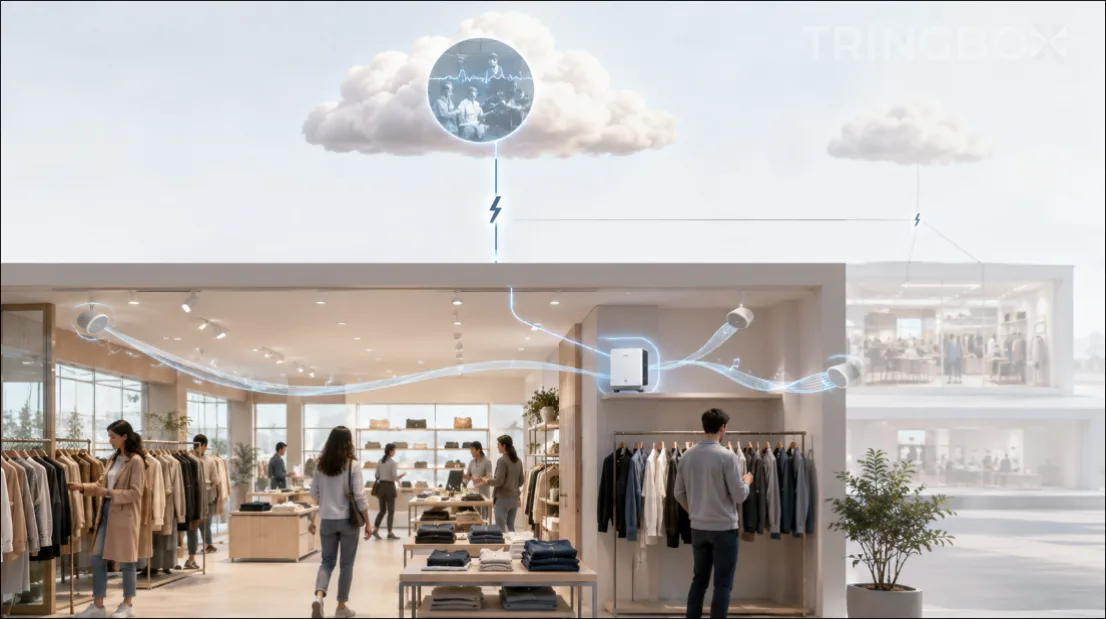
A commercial venue can easily lose external internet connectivity even when its local electrical power, amplifiers, and in-ceiling architectural speakers are functioning in perfect order. If a commercial brand's in-store music system depends entirely on an uninterrupted, live cloud stream, a minor ISP glitch or local Wi-Fi drop instantly turns into a catastrophic customer experience failure within seconds.
In a physical retail or hospitality space, background music is not an optional decorative layer; it is the fundamental acoustic operating system that masks background mechanical noise, protects conversational privacy, and establishes the emotional tone of the space. Therefore, true offline playback capability is not a luxury software add-on or a secondary feature. For multi-location enterprise brands, it is a non-negotiable operational resilience requirement.
The global enterprise audio market already recognizes this structural necessity. Market leaders and enterprise platforms emphasize cached offline playback, dedicated edge players, and encrypted local storage specifically to protect uptime. The foundational engineering principle is clear and uncompromising: central cloud governance and local physical execution must be capable of separating temporarily without degrading the customer experience.
In this comprehensive architectural guide, we explore why streaming buffering is fatal in commercial environments, what components must be cached on edge hardware, how to survive sudden venue reboots without internet, and how Tringbox AI delivers unbroken sonic continuity across distributed enterprise estates.